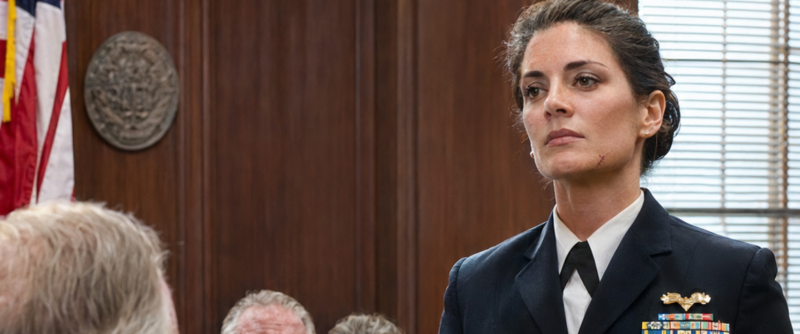
The moment I walked into a Maryland courtroom in my Navy dress uniform—the exact same uniform my parents once considered a family disgrace—the entire room fell silent.
My father let out a small laugh when he spotted me, while my mother shook her head, visibly mortified.
When Judge Prescott glanced down at my ribbons and murmured, “My God… is that really her?” it hit me: my parents had walked into that courtroom without the slightest idea of the woman their daughter had become.

Two days before the hearing, I was outside pruning rose bushes around my small home near Annapolis when a cream-colored envelope arrived from the county courthouse.
Inside was Case No. 5192C: Merrick v. Merrick.
The paperwork listed Gerald and Loretta Merrick as the plaintiffs and Harriet Merrick as the sole defendant.
My own mother and father were suing me.
I sat at the kitchen table staring at the summons while my hound, Copper, rested his heavy head against my knee.
“Well, Copper,” I whispered, scratching behind his ears, “looks like they finally found another way to talk to me.”
It had been twelve years since I last went home.
After I commissioned, my father never came to see me. My mother sent a single message: “We raised a polite daughter, not a military officer.”
I read those words once, locked them away forever, and stopped waiting for their approval. Instead, I built a career they knew nothing about—serving quietly, running logistics, leading missions, and taking responsibility for sailors whose lives hung on fast decisions.
Then an IED tore through our convoy transport overseas.
I came home with a reconstructed knee, a permanent limp, scars I rarely talk about, and a military disability pension I never mentioned to them.
Before my grandfather Vernon passed away, he left me his countryside farmhouse. Since 2013, I had personally paid every single property tax bill on that land out of my military account—even while deployed abroad.
Now, my parents were dragging me into court, claiming I’d abandoned the property and alleging they had been footing every bill out of pocket.
I stared at the paperwork until my jaw throbbed from clenching it. This wasn’t an innocent clerical error by the county—it was a deliberate lie with an official docket number attached to it.
That night, I opened the heavy wooden chest at the foot of my bed. The familiar scent of canvas, gun oil, and brass drifted up as I lifted the lid. Beneath neatly folded civilian clothes lay my dress uniform, my ribbons, and the folded burial flag from my teammate, Dwight.
Copper watched quietly as I lifted the service jacket.
“They want me in court, Copper?” I whispered, running a hand over the dark wool.
“Then they’re going to see exactly who I became.”
Judge Prescott slammed his gavel down, but the sharp crack was instantly swallowed by my father’s attorney, who stepped forward holding a faded, leather-bound ledger. “Your Honor, we aren’t just suing for title transfer—we are filing criminal fraud charges against Miss Merrick for stealing her grandfather’s estate.”
I didn’t flinch, but my mother’s hands began to shake violently in her lap.
“That’s impossible,” I said, my voice echoing across the silent courtroom as I took my place at the defense table. “Grandpa Vernon signed the deed over to me in 2012, right before I shipped out to officer candidate school.”
“He did,” my father interrupted, standing up without permission, his face flushed red above his stiff collar. “Because you manipulated an old man with early-stage dementia! But what you didn’t know, Harriet, is that Vernon left a codicil. If you ever joined the armed forces, the farm automatically reverted to your parents. You knew that, didn’t you? That’s why you kept your service a secret from him until the day he died!”
The accusation hung in the air like poison. My father’s lawyer laid a document on the judge’s desk, along with a yellowed medical record.
I looked at my mother. She couldn’t meet my eyes. She just stared fixedly at the brass buttons of my uniform, her fingers twisting her pearl necklace so tightly I thought the strand would snap.
Judge Prescott adjusted his reading glasses, scanning the paper. “Mr. Merrick, this codicil is dated two days before Vernon passed away. But it isn’t notarized by the county.”
“It was notarized aboard the naval vessel USS Trenton,” my father replied with a cold, triumphant grin. “By a military notary. Care to explain why your grandfather was on a Navy ship forty-eight hours before his death, Harriet?”
A cold shock swept through my chest. Grandpa Vernon had died in a hospice facility in Annapolis—or so I had been told. In 2013, while I was undergoing basic training, my parents had sent me a single telegram stating he had passed peacefully in his sleep. I was ordered not to come home for the funeral because «it would disrupt his memory.»
“I don’t know what you’re talking about,” I said, stepping closer to the bench. “My grandfather was never in the Navy. He was a civilian accountant.”
“He was never a civilian accountant,” a calm, heavy voice spoke from the back of the gallery.
Everyone turned. Standing near the courtroom doors was an elderly man in a dark trench coat, leaning heavily on a wooden cane. He wore a silver lapel pin—the insignia of Navy Intelligence.
My mother let out a small, terrified gasp. “Arthur… you weren’t supposed to come.”
The old man walked down the center aisle, his cane clicking against the hardwood floor. “Judge Prescott, my name is Captain Arthur Vance, retired. I managed the classified personnel records for the Department of the Navy from 1980 to 2015.”
He stopped next to my father, who had suddenly gone pale, all the arrogance draining from his posture.
“Vernon Merrick didn’t just leave Harriet a farmhouse,” Captain Vance said, opening a worn leather dossier. “He left her a legacy. Vernon was a covert logistics officer during the Cold War. The property tax payments Harriet made from her military account weren’t going to the county. They were paying off a federal indemnity bond placed on the land because of Gerald Merrick.”
I stared at the man, my mind spinning. “Because of my father?”
“Your father didn’t lose his business in 2011 to bad investments, Harriet,” Captain Vance continued, his eyes locked onto my father’s trembling frame. “He embezzled nearly half a million dollars from a defense contractor. Vernon took the fall, putting up his land as collateral so Gerald wouldn’t go to federal prison. The condition Vernon made with the Navy? That Gerald would raise you to honor the family name, and that the moment you earned your commission, the land would belong to you—free and clear.”
The courtroom was so quiet you could hear the hum of the overhead fluorescent lights.
My father sank back into his chair, looking smaller than I had ever seen him. “You had no right,” he whispered to Vance. “That was family business.”
“It was family business,” Vance replied sharply. “Until you forged Vernon’s signature on a fake codicil to steal the farm back and sell it to a private developer next month for three million dollars.”
I stood frozen in the middle of the room, the weight of twelve years of shame, rejection, and isolation crumbling around me in seconds. My parents hadn’t disowned me because I joined the Navy. They had hated my uniform because every ribbon on my chest was a reminder of the honor my father had traded away to save himself.
Judge Prescott’s face turned stern. “Is this true, Mr. Merrick?”
My father couldn’t answer. But my mother suddenly slammed her hands on the table and stood up, tears streaming down her face.
“It wasn’t Gerald’s idea!” she screamed, her voice cracking with decades of stored anguish. “Gerald didn’t forge anything!”
She turned to look directly at me, her eyes wild, desperate, and filled with a truth that froze the blood in my veins.
“I forged it, Harriet!” my mother sobbed, reaching into her purse and pulling out a small, tarnished brass key. “Because your grandfather didn’t put up the land to save your father. He put up the land to hide what’s buried under the floorboards of the master bedroom—and if the Navy takes that property, we are all going to prison!”
My mother’s hands trembled so violently the brass key clattered against the wood of the defense table.
“Quiet, Loretta!” my father barked, his face turning an unholy shade of red as he reached to grab her arm. But for the first time in her life, my mother shoved him away.
Judge Prescott’s gavel slammed down like a thunderclap. “Bailiffs, step between the plaintiffs. Mrs. Merrick, you are under oath. What is buried under that house?”
The room shrank until it was just me, the mother who had spent twelve years telling me I was a disgrace, and a tiny brass key.
“It’s not money,” my mother whispered, her eyes locked on mine, spilling tears over her hollow cheeks. “And it’s not evidence against your father. Harriet… it’s Dwight.”
The breath evaporated from my lungs. The uniform felt suddenly suffocating, the weight of my ribbons pulling me downward.
“Dwight?” I managed, my voice barely audible. “Lieutenant Dwight Vance? He died in the convoy explosion in Iraq. I carried his casket. I brought his flag home.”
“You brought home an empty flag, Harriet,” Captain Vance said softly behind me. His voice didn’t carry shock—it carried a heavy, devastating grief.
I turned to Vance, my mind spinning into dark, jagged pieces. “What are you talking about?”
“Dwight didn’t die in Iraq,” Captain Vance said, closing his leather dossier. “He was intelligence, just like your grandfather. In 2012, a operation went rogue overseas. Dwight made it back to the States severely wounded, carrying classified evidence of a treasonous defense network. He couldn’t go to a military hospital without being targeted. Vernon hid him in the old storm shelter beneath the farmhouse master bedroom.”
My mother buried her face in her hands, her sobs echoing through the high ceilings. “We nursed him for three months in secret. Your father and I… we were terrified. But then the fever took him. When Dwight passed away in early 2013, Vernon knew if the authorities found a dead operative on his land, we’d all be executed for treason. So Vernon sealed the shelter, forged the military death records to give Dwight’s family closure, and placed the indemnity bond on the land to keep the federal government from ever excavating it.”
She looked up at me, her eyes raw with a terrifying truth.
“We didn’t push you away because you joined the Navy, Harriet,” she wept. “We pushed you away to protect you. We knew if you stayed around that house, if you became a real officer, you’d find out. You’d be forced to choose between your oath to the military and your family. We made you hate us so you would never come back.”
The silence in the courtroom was absolute.
Every word hit like shrapnel. The twelve years of cold rejection, the single brutal text message, the icy distance—it hadn’t been shame. It was a crude, desperate shield built by two frightened people who sacrificed their daughter’s love to keep her innocent.
“Then why sue me now?” I asked, looking at my father.
My father finally dropped his head, his hands folded in front of him. “Because the defense contractor Dwight was investigating… they found out,” he muttered quietly. “They threatened to burn the property down and frame you for Dwight’s death using your name on the deed. We filed the suit to strip your name off the property tax records, Harriet. We were going to take the legal fallout, take the prison time, and sell it to a federal conservancy before they could destroy you.”
They hadn’t come to rob me. They had come to fall on their own swords.
Judge Prescott sat in stunned stillness, looking from the brass key on the table to the uniformed woman standing before him.
“Lieutenant Merrick,” the judge said quietly, his authority softening into something almost paternal. “As an officer of the United States Navy, if you accept this evidence, I am obligated to order an immediate federal seizure of your grandfather’s land. Your parents will face criminal charges for concealing a classified casualty and falsifying records. Or… you can claim full title to the property today under your grandfather’s original deed, and handle this outside this court.”
It was the choice they had spent a decade trying to spare me from: my military honor, or the parents who had broken my heart to save my life.
I looked down at my uniform. I looked at the dark wool, the sharp creases, and the silver pin on Captain Vance’s lapel. Then I looked at my mother, whose shoulders were shaking, waiting for the blow she believed she deserved.
I didn’t call the federal prosecutor. I didn’t step back.
Instead, I walked over to the plaintiff’s table, picked up the brass key, and slipped it into the pocket of my service jacket.
“Your Honor,” I said clearly, my voice ringing with absolute certainty. “Case 5192C is settled. The property belongs to me. And as the sole owner and a active naval officer, I am placing the Merrick estate under official military jurisdiction effective immediately.”
I turned to Captain Vance, who gave me a slow, silent nod of respect. Dwight’s memory would be cleared, the network would be exposed, but it would be done under my authority—protecting the secrets, and protecting the broken people who had carried them.
My mother looked up, stunned, as I reached out my hand to her. She took it, her frail fingers clinging to mine as if she were drowning.
My father stood up slowly, tears finally breaking through his weathered face, unable to speak.
We walked out of the courtroom together—not as a picture-perfect family, and not with twelve years of wounds magically healed. But as three survivors stepping into the sharp Maryland sunlight, carrying the truth together at last.
For the first time in my life, when my parents looked at my Navy uniform, they didn’t see shame, and they didn’t see a shield; they just saw their daughter, bringing them home.