My daughter had been sick for almost a year.
For nearly twelve months, my husband, Jonathan, and I had practically lived inside the hospital. We knew the hallways by heart. We knew which elevators were sluggish, which vending machines actually worked, and the names of every nurse on the floor—and they knew us.
Most of all, we knew the exhausting rhythm of Mary’s illness: the endless appointments, the treatments, the brief flashes of hope, and the devastating setbacks that always followed.

Mary was eighteen. She wasn’t Jonathan’s biological daughter, but he had raised her since she was six years old. She called him Dad, and he had truly earned that title. As far as Mary was concerned, he was her father. As far as I was concerned, he was the person I trusted more than anyone else in the world to protect my daughter.
Until the day she died.
That was the day I discovered that even the person standing right beside you through the darkest year of your life can hide something enormous from you.
It started one evening over a tray of lukewarm hospital food. Mary had barely touched her meal. I was sitting beside her bed, holding a cup of cold coffee and watching her push peas around with a plastic fork.
Then she looked up.
«Mom?»
I instantly heard the shift in her voice. «What is it?»
«If I don’t make it… I want to donate my organs.»
I set my coffee down with a clatter. «Don’t talk like that.»
She didn’t smile. «Mom, I’m serious.»
I stared at her. She was entirely calm—much calmer than I was. She reached out and grabbed my hand. «If there’s a chance someone else gets to go home because of me, I want that.»
I couldn’t find the words.
She continued quietly, «I don’t want another family sitting in a hospital room feeling the way we do.»
Those words shattered something inside me. I wanted to tell her she was going to get better. I wanted to tell her we wouldn’t ever have to talk like this. I wanted to believe that everything we were enduring would eventually fade into a terrible memory we could discuss safely from our own living room.
Instead, Mary was certain. She had thought it through, she understood what she was asking, and she wanted her decision respected.
I held her hand and cried. Jonathan didn’t cry. He simply nodded.
«I support whatever you decide,» he told her.
Mary looked at him, surprised. «Really?»
«Really.» He squeezed her hand. «It’s your call.»
I wrestled with it for days. Every fiber of my being wanted to believe Mary would pull through and that the paperwork would never matter. I couldn’t bear the thought of preparing for a future without her. But Mary didn’t change her mind. Eventually, I signed the papers with her. I did it because she was my daughter, and because—even though every maternal instinct screamed at me to fight the reality in front of us—I couldn’t deny her one final wish.
Three weeks later, she was gone.
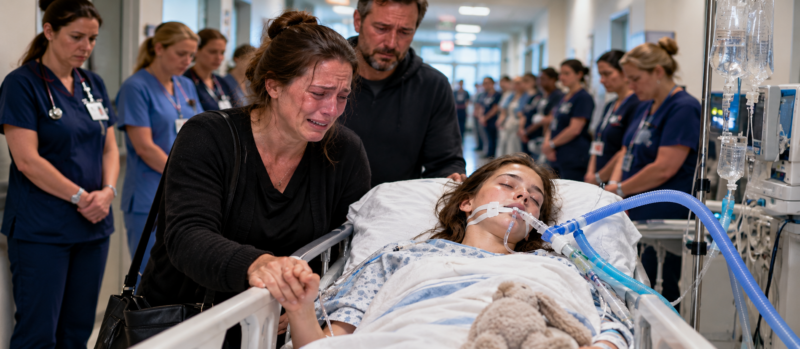
The hospital held an honor walk before taking her to the operating room for the donation surgery. I had heard about honor walks before, but nothing can truly prepare you to walk through one. Nurses and doctors lined the hallway. Some stood with their hands folded, others bowed their heads, and a few quietly saluted. Everyone fell completely silent as Mary’s bed rolled past. It was their way of honoring her decision, her life, and the lives she might save.
Jonathan and I walked directly behind her bed. I barely remember those moments—just the stretch of the hallway, the grieving faces along the walls, the sight of my daughter, and the crushing feeling that the world had stopped turning. I was completely numb inside. Seeing the medical staff show such profound respect for Mary’s final choice undid me entirely.
Jonathan held me tight as I sobbed. «She did something beautiful,» he whispered.
I couldn’t answer. I could barely breathe.
Then his phone rang. He glanced at the screen, and the color drained from his face. «I… I have to go downstairs.»
I looked up through my tears. «What?»
He didn’t explain. He just turned and hurried away down the hallway, leaving me standing there alone.
I was still clutching the ribbon someone had pinned to my sleeve when I heard rapid footsteps behind me.
«Wait! Please, wait!»
I turned around. Mary’s doctor was jogging toward me. I had seen him deliver bad news and good news; I had seen him remain completely composed through the most terrifying moments of my life. But I had never seen this look on his face before.
«Ma’am, I need to speak with you.»
My stomach tightened into a knot. «Is something wrong?»
He glanced down the hallway toward the exit Jonathan had taken, then looked back at me. «Your husband begged me to keep the truth about Mary from you.»
For a second, the sentence didn’t compute. «What truth?» My voice sounded hollow. «Did something happen before she died?»
«Yes.» He took a deep breath. «But it’s not what you think.»
He gently guided me toward a row of chairs against the wall. «I was hoping I wouldn’t have to tell you this today. I thought he had his reasons. But after what just happened with Mary, I can’t stay silent anymore.»
My heart hammered against my ribs. «What is it, Doctor?»
He hesitated. «Before she passed, Mary had questions about whether one of her donated organs could go to someone specific.»
I stared at him. «Someone specific? Who?»
The doctor shook his head. «I can’t tell you patient identities. That’s strictly confidential.»
My mind raced immediately to Jonathan. Every strange moment from the past few months suddenly came rushing back: the late-night phone calls, the times he stepped out of Mary’s room to talk in hushed tones, the visible discomfort whenever Mary brought up her final wishes, and now, the way he had bolted the moment she went to surgery.
Had he pressured our dying daughter to save someone I didn’t even know? Someone he had kept secret from me?
«Was this about my husband?» I demanded. «Did he pressure her into this?»
The doctor looked at me carefully. «I’ve said as much as I can. Please… just talk to your husband.»
And with that, he walked away.
I sat there frozen for several minutes, listening to the muffled sounds of the hospital. My daughter had just died, my husband had vanished, and a doctor had just dropped a bombshell about a secret involving Mary’s organs.
I stood up and went looking for Jonathan.
I found him on the third floor in a small family waiting room, sitting across from a couple I had never seen before. The woman was weeping into a tissue while the man had a comforting arm around her shoulders.
Jonathan looked up. The moment he saw me in the doorway, his face went pale.
«Jonathan.»
He slowly stood. «Grace, I can explain.»
«Then explain,» I said, my voice sharper than intended. «The doctor just told me Mary wanted one of her organs to go to someone specific. And you hid that from me.»
He stood in dead silence.
«Does this have anything to do with these people?» I asked, gesturing toward the couple.
He looked at them, then back at me, offering no answer. That silence was all the confirmation I needed.
«Who are they?» I whispered, my voice shaking. «If you love me, don’t lie to me anymore.»
«I didn’t lie about Mary’s condition.»
«Then what did you hide?»
He looked at the couple one more time, then reached slowly inside his jacket. He pulled out a folded piece of paper with my name written across the front in handwriting I recognized instantly: Mom.
For a fleeting second, my anger vanished, replaced by a cold wave of fear. «When did she write that?»
«Last week.»
«And you’ve had it this whole time?»
He nodded grimly. «She made me promise not to give it to you until… until after.»
I stared at him, snatched the letter from his hand, and said, «I need to read this alone.»
«Grace—»
I walked away before he could finish. I found the hospital chapel, slipped into the back row, and unfolded the paper with trembling hands.
The very first word broke my heart:
Mom,
I stared at that single word for a long time before forcing myself to read on.
If you’re reading this, it means something I hoped for actually happened.
I froze again. What had she been hoping for?
The letter explained that during her treatments, Mary had made a friend named Sophie. They had met in the hospital and spent hours playing card games when they were both too weak to do much else. Mary wrote that Sophie always cheated at cards, but they would just laugh about it—a tiny, painfully normal moment in an otherwise brutal environment.
Then came the part that had been kept from me. Sophie had been waiting on a transplant list for nearly two years. At first, she was just another sick kid sharing the same world of tests and uncertainty. But eventually, Mary started watching Sophie’s mother.
She wrote that Sophie’s mother sat in the waiting rooms the exact same way I did—watching every doctor’s expression, bringing coffee and forgetting to drink it. And one day, Mary realized she wasn’t just looking at another family. She was looking at us.
I wiped tears from my face and read the sentence that changed everything:
That’s when I asked Dad to help me find out if I could directly donate one of my organs to Sophie.
My eyes squeezed shut. Jonathan had known. Mary had asked him, he had helped her navigate the paperwork, and then Mary had explicitly told him to keep it from me.
The letter continued:
Dad told me to tell you.
I stopped reading for a moment. Then came the next sentence:
I said no.
My vision blurred with fresh tears. It wasn’t because Mary trusted Jonathan more than me, or because she loved me any less. She explained why:
It’s because you were still talking about me coming home.
Those words cut straight through me. I remembered saying it over and over again—when you come home, when you’re better, when we get out of here. I had said those things because I desperately needed to believe them. And I remembered how Mary would just smile gently, never correcting me, never letting on how terrified she truly was.
The letter went on:
I knew you needed that hope. I couldn’t make you sit beside me while also waiting to find out whether another girl might live because I died.
I pressed my hand over my mouth, sobbing uncontrollably.
I couldn’t go home with you, Mom. But I hoped I could help Sophie go home with hers.
At the bottom of the page, Mary had added a final postscript:
Please don’t be too angry with Dad. He hated keeping this from you. I made him promise. I love you, Mary.
I held the letter tightly against my chest. For the first time since the doctor intercepted me, I understood. Jonathan hadn’t been deceiving me out of malice; he had been guarding Mary’s final secret because she begged him to. But understanding why didn’t make the hurt go away.
The chapel door creaked open behind me, and I knew before turning around who it was. Jonathan sat quietly in the row behind me.
«You still should’ve told me,» I whispered through my tears.
«I know.»
«She was eighteen,» my voice cracked. «Everyone had control over her body for a whole year. She asked me for control over just one thing.»
Jonathan’s voice broke. «You still should’ve told me.»
«I know,» he repeated, looking down at his hands. «But how could I refuse my daughter’s dying wish? I couldn’t take that choice away from her too.»
I thought about the couple upstairs. «The couple…»
«Sophie’s parents,» he swallowed hard. «She’s in surgery right now getting a kidney.»
«Mary’s?»
«The doctors won’t confirm anything, but considering the timing…»
I looked back down at the letter. «Why did you beg the doctor not to tell me?»
«Because I promised Mary.»
I was still angry, but now I understood what that secret had cost him, too. I carefully folded the letter, stood up, and said, «I want to meet Sophie’s parents.»
When we returned to the waiting room, the couple stood up immediately. Jonathan introduced them: «Grace, this is Ellen and Mark—Sophie’s parents.»
Ellen looked terrified to even speak. She took one hesitant step toward me and whispered, «I’m so sorry.»
«For what?» I asked.
Her eyes welled up with tears. «For being happy today. I don’t know how else to say it. This is the worst day of your life, and we just got the call we’ve been praying for.»
I looked at the untouched cup of coffee beside her chair, then noticed how she kept nervously twisting her hospital visitor badge around her fingers. In that instant, I saw what Mary had seen: another mother waiting for news, watching doctors’ faces, praying for a miracle, and terrified of losing her child.
«You’re allowed to be happy,» I told her.
Ellen broke down crying, and I almost did too. «Mary wanted this.»
She covered her mouth. «We didn’t even know at first. Sophie told us Mary asked questions, but Jonathan made it very clear there were no guarantees.»
«He told us not to get our hopes up,» Mark added gently. «Everything depended entirely on the medical team.»
That sounded just like Jonathan—cautious, practical, and trying to shoulder an impossible burden.
«How close were they?» I asked.
Ellen smiled through her tears. «Closer than either of us realized.» She told me about the time a nurse had to separate Mary and Sophie because they were laughing too loudly while other patients were trying to sleep.
For the first time all day, a ghost of a smile touched my lips. For a brief moment, no one was talking about Mary as a patient, a tragedy, or a donor statistic. They were talking about her as an eighteen-year-old girl. Just Mary.
Then Ellen looked at me. «Mary talked about you all the time.»
«What did she say?»
«She said you worried way too much.»
Despite everything, I let out a dry chuckle. «That sounds about right.»
«She also said you always pretended not to cry.»
My smile faded. «What else?»
Ellen’s expression softened. «She said whenever she was scared, she thought about going home with you.»
I looked down at the letter in my hand. She had been scared; she just hadn’t wanted to burden me with it. She had protected me in the only way she could.
Just then, a nurse appeared in the doorway. «Ma’am? Sir?»
Ellen and Mark stood instantly.
The nurse smiled warmly. «Sophie is out of surgery. She’s stable. The surgeon will be with you shortly.»
The entire room seemed to exhale. Mark pulled Ellen into a fierce hug, and then Ellen looked at me, pure relief washing over her face before a flash of guilt replaced it.
I stood up. «Go.»
She hesitated. «Grace…»
«Go to your daughter.»
She stepped toward me, unsure if she should reach out, so I pulled her into a tight hug.
«Thank you,» she whispered into my shoulder.
I pulled back and shook my head. «Don’t thank me. This wasn’t my decision.» I held up Mary’s letter. «It was hers.»
Ellen wept harder. «Then I will never forget her.»
I knew she meant it. Mark placed a gentle hand over mine. «We won’t let Sophie forget her either.»
That promise hurt, but it also offered something I desperately needed. Mary wouldn’t just exist in our memories as a tragedy; she would live on in another family’s story as the girl who gave their daughter a second chance at life.
As Ellen and Mark hurried down the hallway with the nurse, Jonathan stood quietly beside me.
For a long moment, neither of us spoke.
Then I said, «I’m still angry with you.»
«I know.»
«You kept something massive from me.»
«I know.»
I took a deep breath. «I don’t know if I would’ve had the strength to make that same choice. But… I understand why you did it.»
His eyes filled with fresh tears. That was as close to forgiveness as I could manage today. I reached out and took his hand, and together, we walked back toward Mary’s room.
It was empty now. And somehow, walking into that empty room felt entirely different.
Hours earlier, I had followed my daughter down the hall thinking her entire existence was being erased. In a way, it was. But Mary had understood something vital that I hadn’t: she couldn’t control what was happening to her body, she couldn’t stop the illness, and she couldn’t dictate how much time she had left. But she could choose what she left behind.
Somewhere upstairs, Sophie was waking up. Soon, her mother would sit by her bed and make ordinary plans again—the exact kind of plans I had made for Mary until the very end.
Losing my daughter wouldn’t hurt any less just because another girl survived. There was no miracle big enough to fill the void Mary left behind. But now, I finally understood what she had tried to give me. She hadn’t left me a reason for her death; she had left me something to hold onto in the aftermath.
She couldn’t come home with me, so she helped another daughter go home to her mother. And for the first time since her passing, I understood that her final act wasn’t about dying—it was about giving someone else the chance to live.
Mary had spent her final days thinking of others. While I was consumed by my own desperate need for her to survive, Mary was thinking about what good she could still do if she didn’t.
That was who my daughter was. Eighteen years old, terrified, exhausted, still longing to go home—and yet, even at the edge of the end, looking out for someone else’s mother.
I folded Mary’s letter one last time, pressed it to my heart, and whispered the only words I had left to give:
I love you too, Mary.
Then I looked down the hallway where Sophie’s family had gone. Somewhere beyond those doors, another mother was finally holding onto hope. And that hope existed because my daughter chose to give it to her.