When I was eight, my mother gave our best food to a homeless teenager while my family was struggling to make ends meet, leaving me convinced he was taking something meant for us. Years after leaving home, I finally returned after her funeral to find a man I barely recognized waiting outside our old house in Bluebell Valley.
I was only eight years old when Gabriel first started sleeping beside the municipal dump beyond Oakridge Avenue, taking shelter under a sheet of rusted tin. He couldn’t have been more than eighteen—hollow-cheeked, wearing dirt-stained sleeves, with the guarded eyes of someone used to expecting trouble. Dad had died that spring, leaving Mom with mountain of unpaid bills, overwhelming grief, and a kitchen where every meal required careful math. Yet every afternoon, Mom packed a plate, wrapped it in foil, and walked toward the dump without explaining herself to anyone.
Sometimes Gabriel got baked chicken while my little brother and I ate thin broth. Sometimes he got fresh bread while Mom claimed she wasn’t hungry. Watching him accept those meals with both hands, thanking her like she had saved his life, filled me with a quiet resentment. I couldn’t fathom why a stranger deserved more than her own children.
One Saturday, I saw Mom carrying a freshly baked apple pie toward the back door, its glass cover fogged with heat.
“Is that for dinner tonight?” I asked, my mouth watering for my favorite dessert.
Mom shifted the dish against her hip, avoiding my eyes. “It’s for Gabriel. There’s vegetable soup on the stove for us.”
Something in me snapped. Tears spilled over as my frustration boiled over. “Why does he get dessert when we don’t even have real food?” I shouted.
Mom turned on me with a sudden, sharp fury that stopped my crying cold. “Never say that about Gabriel again,” she snapped sternly, “and never let me hear it ever again.”
She carried the pie outside, leaving me alone in the dim kitchen—ashamed, furious, and convinced Gabriel had replaced me in her heart. From that day on, I hated him with the intense focus only a heartbroken child can manage. Whenever I passed the dump, Gabriel would try to wave. Once, he carved me a small wooden songbird and offered it with a shy smile. I let it fall beside his worn shoes and kept walking.
“You don’t have to like me,” he said quietly, picking up the carving. “But your mother worries when you walk too close to traffic.”
I ignored him, pretending his concern was just another trick to steal Mom’s affection.
Years passed. Gabriel disappeared from the dump before I finished high school, and Mom refused to say where he had gone. The moment I graduated, I moved three hours away to a small apartment in Pine Ridge and rarely called home. Our relationship withered into distant holiday check-ins.
Eleven years later, a call from a hospital nurse broke the silence: Mom had suffered a severe stroke. By the time I reached her bedside at St. Jude Regional Hospital, she was surrounded by monitors and barely able to speak.
I held her frail hand, apologizing for the years of distance. Her fingers tightened weakly, her eyes sharp despite her failing body.
“I’m here now, Mom,” I whispered. “I’ll handle the house, the bills, everything.”
Her mouth moved, straining until a faint whisper came out: “Don’t abandon Gabriel. Promise me.”
A flash of anger hit me before grief washed it away. Gabriel hadn’t even shown up to see her, yet she was spending her last breath worrying about him.
“I promise,” I replied, the words tasting bitter. She closed her eyes and passed away quietly before sunset.
After the funeral, I packed a warm pot of beef stew and drove back to our old neighborhood to fulfill my reluctant promise, assuming I’d have to track Gabriel down around town or at the dump.
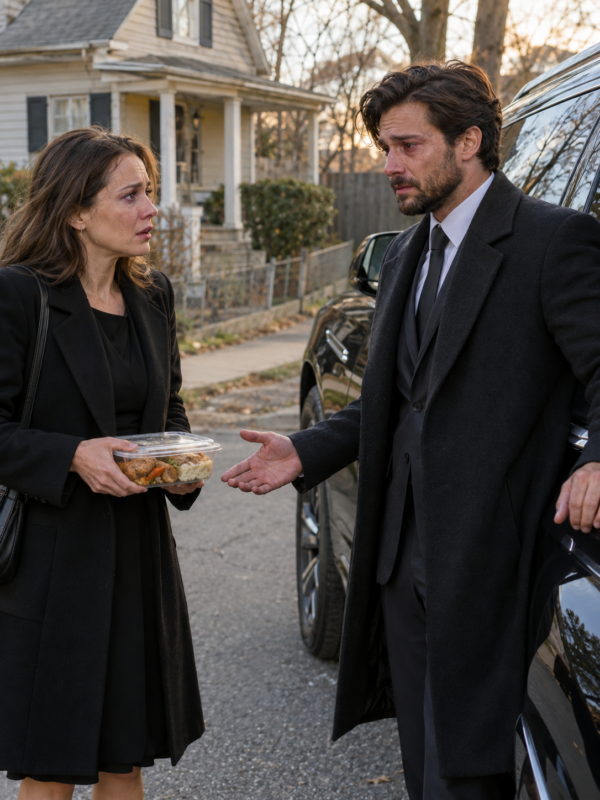
Instead, a sleek black SUV was idling outside Mom’s house. Standing beside it was a clean-shaven man in a tailored wool coat, watching my car pull up with tears in his tired eyes.
I stepped onto the curb, clutching the covered pot to my chest, searching his refined features until I saw the boy from the dump beneath them.
“Gabriel?” I asked, stunned.
He gave a small, uncertain smile. “You brought dinner.”
“What happened to you?” I stammered, looking at the luxury car. “How is this possible? Mom spoke as if you were still living nearby, struggling to get by.”
Gabriel looked toward the dark windows of the house and let out a heavy sigh.
“Your mother hid something very important from you,” he said softly. “Before she died, she begged me to keep her secret until the right moment.”
A cold chill ran through me in the dim evening light. “What did she hide from me?”
Gabriel opened the back door of his SUV and pulled out a dented, decades-old metal box, placing it carefully on the hood.
“Your father’s death wasn’t the first thing connecting my family to yours,” Gabriel said. He explained that his mother, Clara, used to clean offices at my father’s factory. When Gabriel was sixteen, Clara fell gravely ill. Their landlord evicted them, but my father quietly paid for a motel room, dropped off weekly groceries, and helped Gabriel apply for job training programs.
After Dad died unexpectedly, Clara’s health rapidly declined, and Gabriel left high school to care for her until she passed away. Orphaned and homeless at seventeen, he ended up at the dump, taking odd cash jobs at a nearby recycling yard.
“Mom fed you because Dad would have done the exact same thing,” I realized aloud. “Even when our own cupboards were empty.”
“That explains the meals,” Gabriel agreed. “It doesn’t explain the secret she kept for eleven years.”
He unlocked the box with a small brass key from his wallet. Inside were dozens of neatly organized cassette tapes, labeled in Dad’s familiar handwriting: When You Think Nobody Understands You, Eighteenth Birthday, High School Graduation, Wedding Day, First Big Failure, Becoming a Parent.
My knees buckled at the sight of his writing. Gabriel caught my arm, but I pulled back.
“He recorded these for me?” I asked, my voice cracking.
Knowing his health was failing, Dad had recorded messages for the milestones he knew he wouldn’t live to see. He had entrusted the box and key to Gabriel, asking him to deliver it to me on my eighteenth birthday, fearing Mom’s overwhelming grief might lead her to lock the tapes away forever.
“So why didn’t you give them to me?” I demanded.
“Your mother stopped me,” Gabriel said quietly. She had listened to just one recording after Dad died and was crushed by the weight of hearing his voice again. Fearing the tapes would trap me in permanent grief, she pleaded with Gabriel to hold off. “Every year, I came back and asked if you were ready. Every year, she said no.”
Anger flared in my chest. “After I turned eighteen, she didn contesting my right to make that choice. And neither did you.”
“I know,” Gabriel said plainly. “I shouldn’t have gone along with it. But your mother fed me, paid for my night school tuition, and treated me like family when I had no one. My gratitude turned into obedience, and my obedience turned into fear of betraying her.”
“And the car? The coat?” I asked, gesturing toward the SUV. “Was Mom feeding a secret millionaire all those years?”
Gabriel offered a faint smile. His years working at the recycling yard had given him a deep understanding of scrap materials and logistics. After finishing night school, he borrowed a truck to haul industrial scrap, eventually building a successful regional recycling enterprise based in Maplewood. He had moved away years ago, returning only in secret to check on Mom during her illness.
“You weren’t at the hospital when she died,” I noted.

“I was there the night before,” Gabriel admitted softly. “When she learned you were coming, she asked me to leave. She wanted one last conversation with you without the weight of the secret between you.”
“Then why mention your name to me at the very end?”
“She knew you’d return to settle the house,” Gabriel explained. “She was terrified you’d refuse to ever speak to me again, so she made you promise not to abandon me—knowing it was the only way to get us into the same room so I could give you these.”
We carried the heavy metal box into the dusty kitchen. When Gabriel offered to leave so I could listen alone, I stopped him. “You waited eleven years to deliver this. You can stay for one recording.”
We retrieved Dad’s old cassette player from a cabinet, cleaned the heads, and pressed play. Soft static filled the room, followed by my father’s voice, coming from a place far beyond the years of silence.
“Happy eighteenth birthday, my sweet girl,” Dad’s raspy voice echoed. “I hope you’re taller than me now, though your mother probably doubts it.”
He talked about the day I was born, his terror when he first held me, and his hopes for my future. Then his tone softened: “Your mother may hold on too tightly to you after I’m gone. Be patient with her, but please don Valuation completely disappear from her life. And please don’t judge her for feeding a boy with nowhere safe to go. Families survive hard years because people share what little they have.”
I sat at the kitchen table, weeping quietly into my hands as years of childhood bitterness melted into grief.
“He knew,” I whispered.
“He knew her health was fragile back then,” Gabriel said softly. “He worried I’d end up alone, and he feared you’d misunderstand why she kept helping me.”
“You still kept these from me for eleven years,” I said, wiping my face. “His words don’t erase that.”
“I know,” Gabriel replied. “There’s no explanation that makes it right.”
We stayed up listening to the tapes until midnight. There were no hidden fortunes or dramatic scandals—just my dad’s corny jokes, practical advice, and quiet love.
Over the next few weeks, Gabriel visited regularly. Between listening to tapes, he shared memories of my parents from before grief had reshaped our home—how Mom used to sing while balancing bills, how Dad burned pancakes every Sunday, how they worked through every disagreement together.
I finally confessed how much I had resented him as a child, thinking every plate of food Mom carried outside was proof she loved him more.
“I knew you hated me back then,” Gabriel said gently. “But you were eight years old, grieving your dad, and nobody had explained anything to you.”
Healing didn’t happen all at once, but our trust rebuilt steadily through shared meals and quiet conversations. Eventually, I digitized every recording to preserve them safely, donating a few broader recordings on grief and community care to the local history archive. Inspired by my father, I also began recording video messages for my own children—sharing family recipes, advice, and stories to ensure we stayed close.
A year after Mom passed, Gabriel came over for dinner. I placed a warm apple pie in the center of the table and turned on the final cassette tape.
Dad’s voice filled the kitchen one last time, warm and amused: “If Gabriel is sitting there with you, make sure to give him the larger slice—that boy never eats enough.”
Gabriel looked at me across the table with a quiet smile. I looked down at the pie, remembering the eight-year-old child who thought a missing slice of dessert was an unforgivable betrayal.
I cut two equal pieces, slid one toward Gabriel, and smiled.
“I think we’ve both waited long enough for this,” I said.