It all started when my hospital supervisor held me past the end of my shift.
“You’re stuck, Kayla,” she said. “Two of my night nurses are trapped on Highway 10, and a county plow just flipped over near Foley. I need you to stay until backup gets here.”
The emergency room was overflowing with cold-weather injuries. A man in bed six was complaining of chest pain, while a teenager in bed nine needed a dislocated shoulder set. With the night crew stranded, I stayed. I couldn’t just walk away from patients who needed me, shift or no shift.
At 8:15 p.m., while rushing between checking vitals and hanging IV bags, I sent a quick text to our family group chat: “Mandated over at work. Night nurses are stuck in the storm. Roads are terrible, so I’m going to be late. I’m sorry.”
My mom reacted with a heart icon. A minute later, my dad sent a one-word reply: “Read.”
Marisol noticed me staring blankly at the screen. “Your dad again?”
I nodded. She leaned against the nurses’ station counter. “You know that night-shift position is still wide open. 7:00 p.m. to 7:30 a.m., an extra $4.50 an hour, and nobody standing over you counting the minutes.”
I gave her my standard excuse: “I can’t. House rules.”
By 10:01 p.m., I checked my phone between patients. Nothing. Brooke, one of the night nurses, finally brushed through the ambulance doors at 10:15, covered in snow and full of apologies. I handed off my patient load, grabbed my bag, and headed out to scrape my windshield at 10:25.
As I worked, I rehearsed what I’d say to my dad: “I’m sorry, Dad. I couldn’t just walk out. They needed me.” I said it out loud twice, the same way I used to practice lines for high school plays.
With Highway 10 closed, I took County Road 75 toward Sauk Rapids, crawling through the blinding snow at thirty miles an hour.
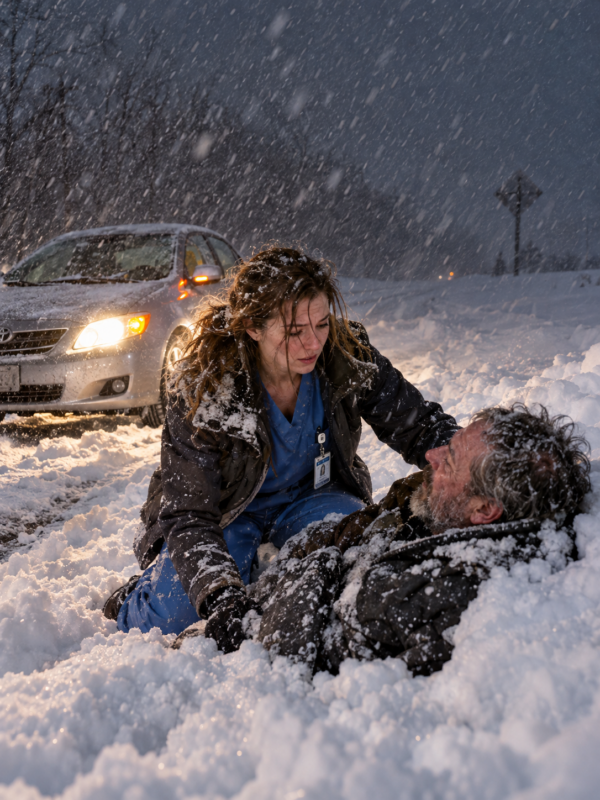
Fifteen minutes into the drive, I spotted faint orange hazard lights flickering down in a ditch, almost buried. A sedan was nose-first in a drift, snow completely covering its back window. I pulled over onto the shoulder, switched on my hazards, and dialed 911. Nursing school strictly teaches you never to create a second patient, but I couldn’t just keep driving.
Scrambling down the embankment, I found an elderly man sitting against his front tire. He was in his seventies, with a white mustache, frozen blood smeared across his forehead, and a wrist bent at a sickening angle.
“A deer,” he stammered through violently chattering teeth. “Swerved for a deer, ended up in the ditch.”
His name was Walt. He had tried digging his car out, slipped, and couldn’t climb back up the steep slope with only one working hand. Then his engine died.
Bracing my boots against the ice, I pulled him up, inch by grueling inch, until I got him into my heated passenger seat. His jacket was soaked through, so I swapped it for mine and wrapped his legs in the silver emergency blanket from my trunk. I didn’t rub his freezing hands; instead, I kept him talking to monitor his condition. He told me his wife’s name was Joanie, and that he’d driven a county snowplow for thirty-one years.
“I used to clear this exact road,” he said, breaking into a laugh that quickly turned into a deep cough.
I stepped back out into the biting wind to dig snow away from my exhaust pipe so carbon monoxide wouldn’t back up into the cabin. Walt asked what I was doing, and I explained the risk. He studied me for a second, giving a tired nod of approval.
“Good girl. Joanie would like you.”
State Trooper Hansen finally arrived at 11:20 p.m., with an ambulance right behind him at 11:38. Both had crawled through the unplowed drifts. I gave the paramedics a crisp hand-off report covering his exposure time, wrist fracture, head wound, and drop in body temperature. Trooper Hansen took down my contact information.
“If his family wants to reach out,” I told him, “that’s fine.”
The paramedics wheeled Walt away on a stretcher, still wrapped in my coat. I let him keep it; he needed it a lot more than I did.
Busy helping Walt, I had completely lost track of time. Back in my car, the dashboard clock read 11:55 p.m. On the drive home, I kept convincing myself my dad would understand. Saving a life couldn’t possibly count as a curfew violation.
I clung to that hope as I turned into Larksburg Court, parked, and walked up the front steps. But when I pushed on the front door, it only opened a couple of inches before catching hard on the safety chain.
The sight made my stomach drop. It had happened before, though I’d prayed it never would again.
At 12:20 a.m., I sat in my running car and dialed my dad. Five rings, then voicemail. I called back. Nothing. I tried my mom—no answer. Then, at 12:31 a.m., a text popped up from her: “I’m so sorry, honey. Please keep the car running. Your father is firm on this. Doors open at 6:00.”
I read it three times before the reality set in. My mother was wide awake, knew I was sitting outside in the freezing cold, and was choosing to go back to sleep rather than unhook the chain.
My breath fogged the windshield as I tried to wrap my head around how I’d ended up here. Eighteen months ago, I had graduated nursing school $38,000 in debt. My dad had offered a deal: “Live at home, save your money, and follow the rules.”
Every month on the first, I paid him $600 in rent, plus another $150 for the blue Corolla registered in his name. He had laminated his rules and stuck them to the fridge with a magnet: Curfew: 10:00 p.m. weeknights, 11:00 p.m. Saturdays. No locking bedroom doors. Location sharing stays on. Guests require 48 hours’ notice. And at the very bottom, underlined twice: Doors open at six.
My twenty-year-old brother, Tyler, lived in the same house without a single rule. He went to community college, worked at a tire shop, and came and went as he pleased. The one time I called out the double standard, my dad barely looked up from the papers he was grading.
“Your brother isn’t the one who’s going to be walking to a car alone late at night.”
I never brought it up again.
Sitting outside the locked house, I thought about calling back, but begging had never worked with him. I shut off the engine, curled up in my damp scrubs, and listened to the howling wind.
The freezing air brought back a flood of memories from an autumn night when I was seventeen, stage-managing the high school play. Dress rehearsal had run late, and afterward, the director’s car wouldn’t start. A fourteen-year-old freshman named Ava was left standing under the lone parking lot light, forty minutes away from her parents. I refused to leave her there alone. When her mother’s minivan finally pulled up, I rushed home as fast as I could.
It was 10:40 p.m. when I got to the door. It caught on the chain, opening only three inches. I knocked lightly once. The light in my parents’ bedroom immediately went out. That was my answer.
It was thirty-eight degrees that night. I wrapped myself in a tarp from the patio furniture and lay on the porch swing, freezing and staying perfectly still so the rusty chains wouldn’t creak.
At exactly six in the morning, the chain slid free. My mom came to the door, red-eyed, offering me hot cocoa without making eye contact. My dad sat at the table reading the paper over coffee like it was any other Saturday.
“Consistency is love, Kayla,” he told me. “The world doesn’t make exceptions, so neither do I.”
He launched into his favorite story about a nineteen-year-old named Dany who died crashing into a tree after a late party because his parents hadn’t set a curfew. “Rules are how I keep you alive,” he said, turning the page.
I came down with bronchitis after that night, but I kept going to rehearsals, quietly coughing into my sleeve. No one at home ever spoke of it again. Ava gave me a thank-you card on opening night, which I hid in my desk like evidence of a crime. That night, I promised myself I’d never be late again—a promise I kept for seven years.
Now, at twenty-four, my nursing license trusted me with critical decisions that kept people alive. Yet at my parents’ front door, I was still a child being punished behind a locked chain.
I went over my actions like a medical chart, desperately searching for where I’d messed up. Perfection had ruled my life: straight A’s, coming home early, apologizing before anyone could even express disappointment. I had even chosen nursing partly because it was a career my father couldn’t criticize. At my pinning ceremony, he’d hugged me and said, “I’m proud of you.” Then he added, “Now don’t get a big head.” That warning had stayed with me far longer than the praise.
Four months ago, I had turned down Marisol’s offer for the higher-paying night shift, despite the valuable trauma experience it offered, simply because the hours violated curfew. My dad had approved of my decision with two short words: “Good choice.”
I secretly had $5,200 stashed away in a separate credit union account, planning to move out in June once I had enough for a security deposit and a car in my own name.
Sitting in the Corolla, I replayed the whole evening: my 8:15 text, saving Walt, giving my report, the brutal drive. For the first time in my life, a overwhelming realization washed over me: I had done everything right.
My phone buzzed, displaying an unfamiliar number.
“Hi, is this Kayla? I’m Walt’s daughter, Dana. The trooper gave me your number. Dad is in the ICU, but he’s stable. The doctor said if you hadn’t stopped, he wouldn’t have survived the night. I don’t even know your full name.”
I stared at the screen before typing back in my practiced, professional tone. I gave her my name, expressed relief that he was stable, and asked if they had treated his wrist and stabilized his body temperature. Dana messaged back quickly, her words filled with typos. They were slowly warming him up; his wrist was broken in two places, and he kept asking about the nurse in blue scrubs.
Despite my freezing surroundings, Walt’s concern brought a faint smile to my face.
Then, because making a plan was the only way I knew how to cope, I mapped out a survival schedule for the rest of the night. I’d run the heater for ten minutes every hour, keeping the driver’s window cracked. Every fifty minutes, an alarm on my phone would wake me to check and clear the tailpipe before starting the engine. I knew the signs of carbon monoxide poisoning all too well: headache, dizziness, confusion. Every time the car ran, I performed a mental status check on myself like I would on a patient.
Do you know where you are? Yes, Larksburg Court, outside my own house.
Do you know the date? Of course.
What I couldn’t comprehend was why I was sitting there.
The knees of my scrubs were stiffening from the frozen mud in the ditch. I tucked my hands under my arms, pulled my chin into my collar, and listened to the metallic clicks of the cooling engine.
At 1:00 a.m., Dana sent another text: “Are you home safe? Are you warm?”
I looked up at the dark, silent windows of the house I grew up in, then typed a lie: “Yes, home safe. Get some rest. Thank you for updating me on your dad.”
I flipped the phone face down. It was the first lie I’d told all night, sent only to spare my father the harsh judgment of a stranger who had done nothing but thank me.
At 1:20 a.m., headlights cut through my rearview mirror. Tyler’s red pickup pulled up beside me. He didn’t even look over. Before he could hit the garage door button on his visor, the door was already rolling up.
I leaned toward the windshield. Through the kitchen window, I could clearly see my dad in his robe, holding a coffee mug, standing right by the wall switch. He hadn’t been sleeping. He’d been standing in the kitchen, forty feet away from my car, watching me freeze.
Tyler pulled in, and the garage door shut behind him. Three minutes later, the kitchen light went out, leaving me alone in the dark with the wind.
I texted my brother: “Can you open the front door? I’m out in the driveway.”
His reply came at 1:24 a.m.: “Dad said no. He’s sitting right there. I called ahead before 10 to ask if I could wait out the storm at Jake’s. Sorry, sis.”
I read it twice. My thumb hovered over my dad’s contact card. Now that I knew he was awake, he might actually pick up. I could already hear his calm, calculated voice: “You know the rule, Kayla. The door opens at 6:00.”
I lowered my phone without calling. Crying was a luxury I couldn’t afford—my face was numb, and I needed to conserve every bit of energy.
At 1:48 a.m., Dana texted again: “My dad keeps asking if the nurse made it home okay. He won’t go to sleep until I tell him. He said you gave him your coat.”
I pictured Walt—seventy-one years old, bruised and broken—refusing to rest until he knew I was safe. And then I pictured my father, standing by the garage switch, actively choosing to leave me in the cold.
I didn’t have the energy to construct another protective lie for my family.
“I’m in my car in my parents’ driveway,” I typed back. “My dad locked me out. Curfew. I’m fine though. Keeping the engine running and the tailpipe clear.”
She replied in less than a minute: “What’s your address? Don’t argue with me.”
A short while later, a soft tap sounded on my window. Outside stood a woman in a purple parka, pajama pants, and snow boots, holding a thermos and a bundle. I cracked the door open.
“Kayla, I’m Dana.”

She handed me the bundle: my folded coat, wrapped inside an olive-green wool blanket that smelled of cedar and pipe tobacco.
“The ICU nurse gave me your jacket. And this is my dad’s old army blanket. He made me promise to bring it to you.”
She poured a cup of scalding, sweet coffee from the thermos. It tasted incredible.
“Come home with me,” Dana insisted. “I’ve got a warm couch and a furnace.”
I shook my head. “If I leave, it’s only going to make things worse.”
Dana stared at me, dumbfounded by how casually I dismissed my own suffering. “Honey, it’s already worse. It’s twelve below zero out here.”
When I held my ground, she climbed into the passenger seat where her father had sat an hour earlier and stayed for twenty minutes. She talked about Walt complaining about hospital coffee and mentioned her bakery in Sartell, all while casting furious glances at our dark house.
Before heading back to her car, she looked at me firmly. “Somebody needs to know about this.” She wasn’t asking for my permission.
Wrapped in Walt’s army blanket, I drifted in and out of sleep between my fifty-minute alarms. By 3:00 a.m., the dashboard thermometer hit twelve below zero.
At precisely 6:00 a.m., the faint sound of the front-door chain releasing echoed across the quiet driveway.
Stiff and shivering, I walked up the porch steps. My dad was waiting in his robe, clean-shaved and holding a fresh cup of coffee. He stepped aside to let me in.
“Good morning,” he said smoothly. “Now you see that the rule stands.”
The house smelled of warm coffee and my mother’s vanilla candles. Inside, everything was immaculate—not a single trace that the night outside had even happened.
I laid out the facts plainly: my mandated overtime, County 75, the crash in the ditch, the ambulance. My dad listened, nodding slowly.
“Then you should have called before 10:00 to ask for an exception.”
“I texted at 8:15,” I said, looking him dead in the eye. “You marked it as read.”
He set his mug down on the counter. “You informed me, Kayla. That is not the same thing as asking.”
I didn’t back down. “Tyler came in at 1:20.”
He didn’t even try to deny it. “Your brother called before 10:00 and asked permission to wait out the storm at a friend’s house. He asked. You announced. There’s a world of difference between asking for permission and making an announcement. That’s the lesson here.”
Then came his favorite line: “Rules are how I keep you alive.”
After that night, my dad reached out to me only once: “Sunday dinner, if you want.”
I replied with my own boundary: “When you can explain to me what happened that night in your own words, I’ll be there.”
He never responded, and I stopped trying to fill the silence for him.
My new night-shift position started on February 9th. The evening that sticks with me most came six weeks later, in early March. It was 6:20 p.m., and a gentle, harmless snow was falling. Dressed in my blue scrubs with my badge and single apartment key hanging from my lanyard, I walked down the outdoor stairs toward my car.
Walt’s army blanket was neatly folded on my back seat. He had stubbornly refused every attempt I made to return it, so I finally gave up. Before hopping into my Subaru, I crouched down to brush a light dust of snow off the exhaust pipe—no longer out of desperate survival, but just as a routine habit, like adjusting my mirrors.
Downstairs, Walt was sitting on his porch in a lawn chair, bundled up in a parka with a weather radio crackling on his knee. His cast was finally off, though he complained endlessly about the supportive brace replacing it.
“County 75 is clear!” he called out. “I checked the reports!”
“You’re not supposed to be monitoring road conditions for me, Walt,” I called back with a smile.
“I’m retired, not dead,” he scoffed. “Drive safe, Kayla.”
I laughed, telling him to get inside before he froze, and he told me to mind my own business—our daily way of saying we cared.
I pulled out of the driveway and headed toward St. Cloud. At the exact hour I used to spend frantically speeding home to beat a curfew, I was now driving away, with no one watching from a window to decide if I deserved to come back.
During that twelve-hour shift, I treated a boy who broke his arm sledding, an elderly woman with pneumonia who squeezed my hand and confused me with her late sister, and victims from two minor fender-benders on Highway 10. Thankfully, no one was severely hurt.
At three in the morning, Marisol walked up to the desk carrying a fresh cinnamon roll from Dana’s bakery. “Look at you, owning the night shift.”
By 7:30 a.m., a brilliant pink and gold sunrise painted the sky over the parking lot. I drove home with the heat blasting and the radio playing quietly. The plows had already cleared the streets.
Downstairs, Walt’s kitchen light was on, and the smell of fresh coffee greeted me before I even reached the top step.
I unhooked the single key from my lanyard, slipped it into the lock, and turned it. The door swung wide open—no chain to stop it, no one standing over me with a mug ready to deliver another lecture, and no one deciding if I’d asked for permission politely enough.
Just my own apartment, a hook for my coat, a jar of peppermints on the counter, and the morning sun streaming across the floor.
I stood in the doorway for a long moment, savoring the feeling of a warm room after a long, cold night.
This time, the door was wide open. And the only rules that mattered were mine.