I Broke My Arm Caring for Our Twin Infants—Then My Husband Said 10 Words That Changed Everything
I broke my arm while caring for our five-month-old twins.
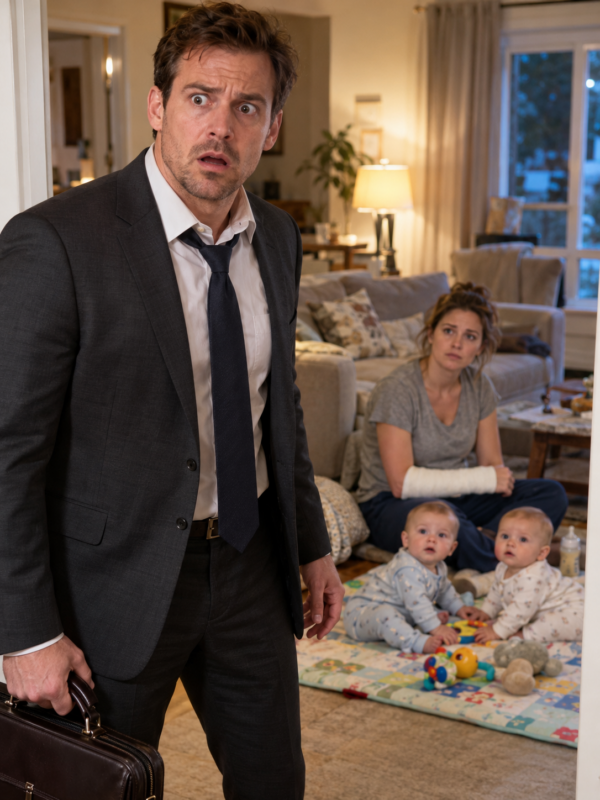
I assumed my husband would see the cast, look at our two babies, and realize I needed a hand. Instead, he looked me dead in the eye and said:
“Moms don’t get sick days. You wanted kids, so you take care of them.”
Those words shifted something deep inside me. Not just because they were cruel—though they certainly were—but because I suddenly realized he wasn’t failing to understand what I needed. He understood perfectly. He simply didn’t believe it was his job to help.
Once that reality sank in, I knew something had to change.
The Fall
A couple of days earlier, I took a hard fall down the stairs at home. It happened in an instant. One second I was carrying something upstairs, and the next I was crumpled on the floor, nauseous from the pain radiating through my right arm.
At the ER, the doctor confirmed my worst fear: a clean break. He put me in a heavy cast and gave strict orders not to lift anything heavy for the next few weeks so the bone could heal.
Under normal circumstances, that would be tough. With five-month-old twins, it was virtually impossible.
Our sons, Luke and Miles, didn’t care that Mommy had a broken arm. They still needed bottles, diaper changes, and baths. They still woke up multiple times a night, and they had an uncanny instinct for crying the exact second I finally sat down. Most importantly, they couldn’t grasp that I wasn’t supposed to lift them.
I could handle the physical pain, but I couldn’t safely carry two squirming infants with only one working arm.
So I asked my husband, Derek, for help. I wasn’t asking for forever—just for him to take a day off here and there, come home an hour early, or work remotely once in a while until the cast came off. It felt like a reasonable request.
Derek rolled his eyes. «I have a job,» he snapped. «I’m not sitting around playing babysitter.»
I stared at him, bewildered. «Derek… my arm is broken. How am I supposed to manage two babies single-handedly? I’m just asking for a little help.»
He shrugged. «Well, sweetheart, you’re the one who wanted kids, so figure it out.» Then came the sentence I’ll never forget: «Moms don’t get sick days. That’s not my problem.»
I sank onto the couch, totally floored. I couldn’t believe the man I married was standing in front of me saying those words.
«Doing Nothing» All Day
The truth was, I had been running myself ragged taking care of our sons almost entirely on my own while on maternity leave. I handled the late-night feedings, diaper changes, soothing, doctor visits, laundry, cooking, and housecleaning.
And for the record, Derek wanted children just as much as I did. We planned this pregnancy together. We talked about becoming parents and dreamed about our future. Yet somewhere along the line, Derek decided that being a father meant providing a paycheck, while actually raising the kids was strictly my domain.
I tried to explain that I wasn’t asking him to take over—I was asking him to step up temporarily while I was physically injured. What more justification did he need?
Over the next few days, I hit a wall of pure exhaustion. My mom, Noelle, started coming over whenever she could. Without her, I would have completely drowned.
But one afternoon, she couldn’t make it, and there was no way I could bathe the twins safely by myself.
When Derek walked through the door after work, I tried again. «Derek, I need your help giving them a bath tonight.»
He crossed his arms. «I just got home. I’m tired.»
«I know you’re tired, but—»
«Why should I have to come home from a full day of work and care for the kids too?» he interrupted. «You stay home and do nothing all day.»
I went completely still. Nothing. That’s what he thought I did all day.
I looked at our two helpless babies, then at my cast, and finally back at my husband. «So caring for two five-month-olds all day is ‘doing nothing’ to you?»
He stayed silent.
Right then, something inside me went cold and quiet. I stopped arguing. I realized Derek wasn’t confused, uninformed, or just burnt out. He had made a deliberate choice. And if he wouldn’t listen to my words, he was going to have to experience the reality himself.
I Stopped Asking
That night, I wrote down a short list—not an angry rant, just the specific physical tasks I couldn’t safely handle while healing:
Bathing the twins
Carrying them up and down the stairs
Prepping evening bottles while managing both babies
Handling at least one night wake-up
I placed the note in front of him. «This is what I need help with.»
He barely glanced at it. «I’m not doing shift work in my own house.»
«Okay,» I said quietly.
It was the first time I hadn’t pushed back, because I finally accepted that begging wasn’t going to work.
While he went to shower, I packed a diaper bag, called my mom, and made a decision Derek never saw coming. I packed up Luke and Miles and went to stay at Noelle’s house.
I wasn’t leaving my marriage or filing for divorce. I was simply refusing to risk further injury just because my husband refused to co-parent the children he helped bring into the world.
Facing Reality
When Derek realized we were gone, his immediate reaction was panic over how bad it looked to outsiders. But the turning point came when his own mother called him out, asking point-blank: Why did Hope have to pack up two infants and leave her own home just to get basic help with a broken arm?
That question cracked his defensive shell.
There was no hidden legal battle, no dramatic ultimatum, and no third parties involved. The issue was painfully simple: Derek had convinced himself that parenting was optional for him, and with us gone, he couldn’t hide behind that delusion anymore.
During his visits to see the boys at my mother’s house, he had to face what being a present father actually required. One afternoon, Miles started fussing. Normally, I would have sprinted over to scoop him up, but this time I stayed seated.
Derek looked panicked. He picked Miles up, but the crying escalated. He shifted him, paced the room, and tried bouncing him—nothing worked. For the first time, Derek was experiencing the sheer trial-and-error uncertainty of soothing a baby.
Eventually, he adjusted his hold, slowed his pace, and rocked him gently until the crying tapered off.

Derek looked at me, breathing a sigh of relief. «I got him.»
«You did,» I nodded.
He was quiet for a moment before admitting, «You always make this look so easy.»
«It isn’t easy,» I said softly.
«You just instinctively know what to do.»
«No, Derek. You learn by being there.»
I hadn’t been born knowing which cry meant hunger or how Luke liked to be burped. I learned because I showed up every single day and night. Derek wasn’t bad at parenting; he had just never stayed in the uncomfortable moments long enough to figure it out.
Beyond a Clean Kitchen
A few days later, Derek sent me a photo of our house. The kitchen was spotless—counters wiped, sink empty, everything put away. He was clearly looking for validation.
I appreciated the clean house, but I didn’t send the praise he was expecting. Instead, I texted back a single question:
What time does Miles usually take his last bottle?
A long pause followed. No response. He didn’t know.
That was the moment the real lesson clicked for him. Maintaining the house, working long hours, and paying the bills were all important, but none of them were a substitute for knowing your own children. Parenting isn’t just checking off a list of household chores—it’s being present enough to know your family.
A Real Partnership
Over the next few weeks, real change began to take root. Derek started leaving the office on time twice a week. He added the babies’ pediatrician appointments to his work calendar. He figured out how Luke liked to be held and that Miles needed to be walked around the room before he would settle down for a nap.
Three weeks later, I brought some of our things back home, though I deliberately left a few bags at my mom’s house. I wanted Derek to understand that I wasn’t coming back because things were magically fixed; I was returning because I saw genuine effort. But I would never again wait until I was physically broken to demand an equal partnership.
One evening, we were sitting in the living room while the babies slept. The house was calm. Suddenly, Miles started whimpering from the nursery over the monitor.
Out of habit, I started to push myself up from the couch. But before I could stand, Derek was already heading down the hallway.
«I’ve got him,» he said over his shoulder. «That’s his tired cry.»
I froze, watching him walk into the nursery. Within minutes, the whimpering stopped and the house fell quiet again.
I sat back down and reached for the mug on the coffee table. The tea in my hands was still warm.
It was such a minor detail, but it felt monumental. For five straight months, every single cup of tea or coffee I made had gone stone-cold while I rushed to handle a bottle, a diaper, a bath, or a crying baby alone.
I used to tell myself that doing it all single-handedly was just what being a good mother required. But that night, I finally realized the truth: being a mother doesn’t mean bearing the entire burden alone, being a father isn’t just providing a paycheck, and being a husband means stepping up when your partner is struggling.
Derek was right about one thing: motherhood doesn’t offer sick days. But marriage is supposed to offer a partner. When one person is hurt, exhausted, or overwhelmed, the other steps in—not as a favor, but because it’s their family, too.
My arm eventually healed, but the lesson we learned rebuilt our marriage into a true partnership. I didn’t need Derek to rescue me. I just needed him to stand beside me—and finally, he did.