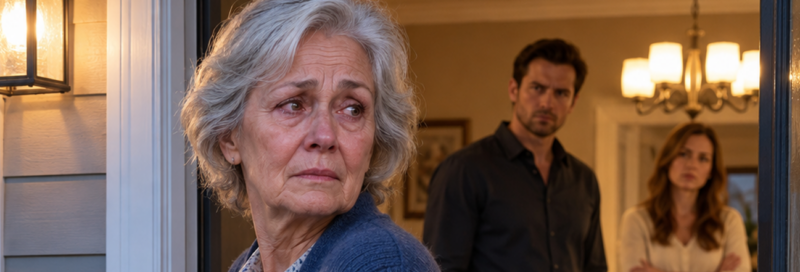
My son gestured toward the front entrance and laid down a blunt ultimatum: “Either you apologize to Khloe right now, or you walk out of my house and never come back.” My nine-year-old grandson sat nearby in tears, while my daughter-in-law stood watching with her arms tightly crossed.
I picked up my handbag and walked out. What neither of them realized was just how much of their comfortable existence had depended on the help I gave quietly, behind the scenes.

My son, Theo, had never addressed me with such cruelty before that night. Standing beside the dining table, he pointed toward the doorway and repeated the demand: “Either you apologize to Khloe right now, or you walk out of my house and never come back.” Hugo, my nine-year-old grandson, kept his gaze fixed on his plate, struggling to hold back tears.
Certain details of that evening remain painfully clear: the circular water ring sweating onto the wood next to Theo’s glass, little Cheyenne reaching beneath the table to clasp her brother’s hand, and the suffocating quiet that followed the ultimatum. At sixty-eight, I felt as though I had turned into an unwelcome stranger at my own family’s table.
The argument had started innocently enough when Hugo asked if I could join everyone for Thanksgiving. Before I could even open my mouth, Khloe announced that she preferred to spend the holiday with only her immediate family that year.
I could have respected that decision. Parents are fully entitled to set boundaries for their own holidays. But she went further, telling me she was weary of my suggestions and resented feeling constantly judged inside her own house.
She began listing her grievances: the time I suggested Hugo put on an extra layer before going outside, and the opinion I’d voiced about Cheyenne’s bedtime. To me, those were just ordinary, harmless expressions of concern from a doting grandmother—though I could admit that being a worried relative didn’t automatically give me the right to hand out unsolicited advice.
“Maybe I should have kept those opinions to myself,” I said. “But I wasn’t trying to hurt you.”
Khloe fired back, accusing me of insisting on always being right and of making Theo feel guilty whenever anyone disagreed with me. When I softly objected to the tone she was using, she shoved her chair backward.
“If you really cared about your grandchildren,” she said, “you would know when you’re not welcome.”
Hugo’s eyes were wet, and Cheyenne had become unnaturally quiet. I wanted to reassure them that adult disagreements weren’t their responsibility. Before I had the chance, Theo brought his palm down hard on the tabletop.
“That’s enough, Mom. Khloe has put up with this for far too long. Apologize to my wife.”
I asked whether he truly understood what he was demanding. He rose and presented his choice: apologize or leave forever. Khloe stood right beside him, arms still crossed. Neither appeared to notice that their children were witnessing everything.
Rather than shouting back, I stood, collected my purse, and answered, “I understand.” I leaned down to embrace Hugo and Cheyenne, reassuring them of their grandmother’s love and reminding them that adult disputes were never their fault. The front door clicked shut behind me.
I sat in my car for a while, hoping Theo might come outside to express regret that the children had seen the confrontation. He never appeared. Eventually, I drove back to the silent house I’d shared with my husband, Sebastian, before he passed away six years ago.
To understand why leaving hurt so much, you need to understand how thoroughly my life had become intertwined with Theo’s household. He was my only boy. After Sebastian’s death, being alone with the empty chair where he once drank his coffee and described his day had become almost unbearable.
I’d worked as a nurse for decades. Retirement brought a reasonably comfortable pension, but it also left me with long, unstructured days. Initially, I visited Theo and Khloe twice a week, helping with school drop-offs, breakfast, and hectic afternoons.
Soon those visits expanded until I was arriving before the children even woke up. I prepared their breakfast, checked backpacks, drove them to appointments and activities, and came back later to straighten the kitchen or throw in a load of laundry. I bought groceries, cooked evening meals, cleaned up afterward, and often stayed until every outstanding task was finished.
Cheyenne attended dance lessons, while Hugo had homework and a crowded social calendar. I moved between obligations with the same practiced efficiency I’d once brought to hospital rounds. I could spot Hugo’s lunchbox instantly and knew precisely where Cheyenne kept her favorite hair accessories.
In those early days, Theo expressed his gratitude frequently. Having people depend on me eased the heavy loneliness waiting for me at home.
Over time, however, polite requests turned into expectations. Khloe started leaving schedules and written instructions on the counter. Theo began informing me of the next day’s pickup schedule without first asking if I was free. My own plans rarely factored into the equation.
I understood that both parents worked full-time and struggled to balance careers with raising two kids. Their household was theirs to manage. Yet whenever I rescheduled a medical appointment to drive one of the children somewhere, nobody knew what I’d sacrificed. They simply saw me arrive punctually, as always.
I should have established limits long before that dinner. Instead, I reassured myself that helping out was simply what family did. I took pride in being reliable, even when the arrangement increasingly resembled an unpaid job with no quitting time.
Our financial arrangement evolved in much the same way. Two summers before the argument, Khloe grew anxious about a roof leak. I spent nearly $25,000 replacing it, unwilling to risk water damaging the bedrooms where my grandchildren slept.
I also covered Cheyenne’s dance fees, costumes, and transportation. The household phone bill was set up to pull automatically from my account every month. Groceries and children’s clothing regularly went into my shopping cart, and whenever an unexpected bill popped up, I was usually the first to offer financial support.
I’d even agreed to co-sign the financing for Theo’s truck. Sebastian and I had been careful savers, and I believed those resources could give the younger generation a stronger financial foundation.
I didn’t require anyone to pay me back. What troubled me was realizing that my voluntary generosity had quietly become a permanent assumption in everyone else’s financial planning.
They also knew nothing about the physical price I was paying. For close to a year, I’d been undergoing treatment for osteoporosis and persistent joint pain. My physician had warned me against carrying heavy objects, remaining upright for extended periods, and failing to rest after long drives.
I kept the diagnosis and those medical recommendations from Theo and Khloe. I feared they would interpret my condition as criticism or an excuse to pull back my help—even though my years in nursing should have taught me the danger of ignoring symptoms.
On particularly painful evenings, I sat wearing my coat indoors because my knees hurt too much to climb the stairs immediately. Housework left my fingers stiff, and long afternoons aggravated my back. Every night I resolved to take things easier the next morning. Then the phone would ring, and that resolve vanished.
After I’d finished cleaning her kitchen one day, Khloe remarked that someone who spent all day at home had no reason to feel exhausted. I just assured her I was fine. Later, placing medication on my bedside table, I wondered how telling the truth had come to feel so intimidating.
I postponed physiotherapy sessions to accommodate Cheyenne’s dance schedule. I also delayed buying the supportive chair my doctor recommended after Theo mentioned another cash crunch. Nobody explicitly forced me to make either sacrifice. I made those choices myself, and acknowledging that was part of understanding how things had gone wrong.
Every sacrifice had an easy justification. I pictured Cheyenne beaming in her dance costume or Hugo waving as he ran into school, and immediately felt guilty for craving a quiet morning. Somehow I’d forgotten that I could adore my grandchildren without disobeying medical advice.
Savings reserved for my own healthcare were gradually being spent on their household, while almost nobody asked about my well-being. I was frightened of disappointing them; they had grown accustomed to never hearing a refusal. That final confrontation tore the curtain off what we had all allowed to develop.
My older sister, Nora, had warned me for years. Following her divorce, she’d settled in Newport, Oregon, in a coastal home with a guesthouse overlooking the local marshes.
Whenever she invited me out, I always claimed I was needed for a school run or one of Khloe’s household projects. Eventually she asked me directly, “Camila, who is going to take care of you when you don’t have the strength to take care of everyone else?”
I just laughed it off. Admitting the truth would have meant facing the reality that constant activity helped me avoid confronting Sebastian’s absence. Feeling indispensable felt much easier than grieving.
The next morning, with my sore knee propped up on another chair, I called Nora from my kitchen. She sensed my distress instantly. “Camila, what’s wrong?”
“Is the guesthouse still available?” I asked. She confirmed that it was and asked if I’d finally decided to visit. “Not just a visit,” I told her. “I need to move out there for a while. I need medical treatment, and I need some rest.”
She didn’t press me for a long explanation. “Then come here, little sister,” she said. “We’ll figure things out one day at a time.” Ever since Theo had shown me the door, I’d felt like belonging anywhere required me to earn it. Nora’s response completely challenged that belief.
Once we hung up, I retrieved the carefully organized financial records Sebastian had left behind. I made a list of the recurring phone bills, dance payments, bank transfers, groceries, and truck financing. The totals were startling. What I had considered occasional assistance had turned into a major chunk of another family’s monthly expenses.
I contacted my bank to halt the automatic transfers, cancel an extra card, and protect the savings I still had left. I also asked about my continuing obligations as a guarantor on Theo’s vehicle loan. Co-signing a debt creates legal responsibilities that cannot simply be wiped away on a whim.
The following Tuesday, wearing my gray coat and carrying the documents, I met Preston Hail at the bank. He’d helped me sort things out after Sebastian passed away and looked surprised by my requests. He carefully explained which transfers could be stopped immediately and which ones required advance notice to service providers.
“Are you certain?” he asked when we reached the recurring transfers. “You’ve kept some of these running for a very long time.”
“I know,” I told him. “That’s why I need to stop.”
We canceled the transactions within my control, set up modifications for the others, and moved my accessible savings into an account solely under my name. Preston offered no judgment. He simply respected my right to make choices about my own resources.
Three days later, as I was packing my suitcase, Khloe called. She showed no curiosity about my health whatsoever. Instead, she opened with, “What on earth have you done?”
The phone and dance payments hadn’t gone through as she’d expected, and she was furious I hadn’t warned them. I explained that my medical needs required me to use my money differently.
“But we’ve always relied on you,” she said. “Do you have any idea what kind of mess this causes us?”
Without waiting for an answer, she shifted gears. “Anyway, you’re still coming over at one to watch the kids, right? I’ve made plans with a friend.” Apparently, the previous dinner’s ultimatum had already slipped her mind.
Looking at my half-filled suitcase, I realized how completely the need to be useful had crowded out my own survival.
“No, Khloe,” I said. “I’m not coming this afternoon. You’ll need to make other arrangements.”
She called me selfish. I listened to her out, still battling that old anxiety about upsetting her, but this time I didn’t back down.
Chapter 2
Khloe warned that if I stopped helping them, the family wouldn’t come to see me and I shouldn’t expect invitations to their home. After helping raise her children, those words cut deep. I asked her, “Do you honestly believe I have to pay your bills and babysit your kids just to earn a place in this family?”
She insisted I was twisting her words. I explained that I’d respect her decision regarding visits, but I would no longer schedule my days around her family’s demands. Once she hung up, I sat holding the phone, shaken but entirely unwilling to buy peace with yet another promise of servitude.
Over the next ten days, I decided to put my Maple Oak house on the market. Sebastian and I had built a wonderful life there. He had planted the flower beds, and we’d handpicked the curtains room by room. Selling wasn’t an act of retaliation; the property was simply becoming too much for me to maintain alone, and I refused to spend my remaining years struggling to upkeep rooms I no longer had the strength to enjoy.
I contacted Peter, a local real estate agent who had represented one of my neighbors. He asked if I’d thought the decision through thoroughly. I appreciated that he treated it with respect rather than dismissing an older widow’s judgment. We discussed the house’s condition, a realistic listing price, and what funds I’d walk away with after moving expenses.
Several potential buyers toured the property. Eventually, a young couple named Daniel and Emily came by. Emily taught elementary school, and Daniel worked as a technician. They admired Sebastian’s garden from the window and talked about sharing their morning coffee on the porch.
When I told them Sebastian had planted the flowers, Emily promised to take good care of them. Their offer was fair, complete with straightforward inspection and closing terms. After reviewing the paperwork, I accepted. I was finally organizing my future around the years I had left, rather than everyone else’s immediate demands.
Meanwhile, Khloe posted online updates about guarding her peace and cutting toxic people out of her life. I didn’t engage. Theo called four times that same weekend; I let every call go to voicemail. His final message sounded more panicked than angry: “Mom, where are you? Is everything okay? Please call me back.”
I heard the message, but I wasn’t ready to reply just yet. For years, I had answered every ring almost instantly. I needed time to breathe and make decisions without an emergency or an emotional argument pulling me back into the old routine.
When the sale finalized, I handed the keys over to Daniel and Emily. Afterward, I lingered alone in the empty living room, remembering young Theo asking Sebastian for a second helping of dessert at that very dining table. I cried, but sadness didn’t mean I had made the wrong choice.
I packed a handful of framed photos of Sebastian, my old nursing notebooks, my medical files, and my clothes. Then I left Maple Oak behind for Oregon. Nora met me at the Newport airport and wrapped me in a tight embrace.
“You actually made it,” she whispered as I cried softly against her shoulder.
Her guesthouse had warm cedar siding and a small porch facing the wetlands. She carried my bags inside and asked if I wanted something to eat or just time to rest. It had been an awfully long time since anyone had offered me a choice centered purely on my own comfort.
We went to a casual waterfront restaurant for shrimp that evening. I enjoyed my meal without frantically checking a child’s schedule or jumping up to pre-rinse dishes. Nora asked if I regretted the move. “I miss them,” I told her honestly. “But I don’t regret needing a life of my own.”
Chapter 3
The first few days in Newport brought a deep, unfamiliar peace. Nora took me to a local farmers market, where we spent ages browsing fresh tomatoes, sweet basil, and jars of local honey. Buying ordinary groceries without coordinating someone else’s timetable felt wonderfully liberating.
One afternoon on her porch, I finally switched my phone back on. A flood of text messages and missed-call notifications poured in, followed immediately by a call from Theo. “Mom, I went by the house,” he said, his voice tense. “There are strangers living there. What happened?”
“I sold it,” I replied calmly. “I’ve moved to Newport.”
He couldn’t fathom that I had made such a major move without consulting him. Then he let slip an admission that stopped me cold: “I always thought that house was going to belong to me someday.”
I reminded him that Sebastian and I had bought it ourselves and had never promised it to anyone. “I’m still alive, Theo,” I said. “I need to pay for my own medical care and plan for my own future.”
Khloe jumped onto the line, taking over the call. She described the property as a family asset and demanded to know why I wasn’t considering Theo’s future. I reminded her of the roof replacement, the dance tuition, the phone bills, and years of endless support. Then I asked why neither of them seemed to care what happened to me.
When I mentioned postponing my physical therapy and draining my medical savings to keep things afloat, Theo sounded genuinely distressed. “Mom, why didn’t you tell me any of that?”
“Because I didn’t want to be a burden,” I admitted. “Yet you’ve spent this entire phone call interrogating me about the house and the money. You haven’t even asked if I arrived safely.”
Neither of them responded right away. Theo urged me to come back so we could sort out the finances. I explained that I was staying put in Newport to focus on my health. I wasn’t rejecting my grandchildren or stopping my love for the family; I was simply letting their parents shoulder their own adult responsibilities. We could talk again when everyone was ready to speak respectfully.
In the weeks that followed, I attended all my medical appointments and rested whenever my body demanded it. Nora suggested we take a watercolor painting class. My first attempt looked more like a muddy landscape drowning in a puddle, and I laughed harder than I had in years.
We went to art exhibitions and joined a local book club. Many of the women I met had spent decades working or caring for relatives, and they, too, were discovering the joy of enjoying their days without constantly apologizing. I still missed Sebastian deeply, but I stopped burying my grief under an avalanche of endless chores.
Pamela, Theo’s cousin, occasionally called with updates from back home. Without my daily assistance, their mornings had turned chaotic. Theo now had to wrangle the kids for school before heading to work, while Khloe scrambled to rearrange extracurriculars, meals, and pickups. Arguments over chores and household expenses erupted, forcing them to reckon with the bills I used to handle without a second thought.
Their struggles didn’t bring me joy. Hugo and Cheyenne deserved a stable, peaceful home. But gradually, Pamela reported positive shifts: Theo adjusted his work hours, Khloe streamlined the kids’ activities, and the couple started splitting the domestic workload much more fairly.
Once, Pamela described finding Khloe sitting on the front steps, totally overwhelmed by the simple task of organizing a single afternoon. I remembered countless afternoons I’d managed for them seamlessly while hiding my own agonizing joint pain. Even so, I felt relieved that their struggles were forcing real teamwork rather than a default expectation that I’d fly back in to fix everything.
Life remained demanding for them, but they were learning to cope. They needed that growth without my constant interference. Over the span of nearly six months, I was learning something equally vital: loving my family didn’t require sacrificing the peace I needed to heal.
Chapter 4
Nearly half a year after my arrival, Theo called one afternoon while Nora and I were sitting on the porch drinking tea. At first, he hesitated. Then he asked quietly, “Mom, how are you?”
Such a simple, caring question nearly brought me to tears.
“I know this is way too late,” he said. “I’m sorry I let you walk out that night. I shouldn’t have made you choose between apologizing to Khloe and being part of our family.”
I explained that the financial support and the exhausting chores hadn’t wounded me nearly as deeply as the realization that my own son could discard me so easily when I needed him to see me as a person. Theo listened without getting defensive. Having to manage meals, school mornings, and household bills on their own had finally forced him to realize just how much he’d taken for granted.
“I had no idea about your health issues,” he said softly. “But I should have been paying attention.”
I made it crystal clear that I wouldn’t be moving back to resume our old arrangement. He quickly assured me he wasn’t asking for that—he just wanted to apologize and hoped I might eventually forgive him. We talked at length about Hugo and Cheyenne, who still asked about me constantly. I told him I loved all of them, including Khloe, but insisted that any future relationship had to be built on mutual affection, not forced servitude. I hung up feeling cautiously optimistic, knowing years of entrenched habits couldn’t be erased by a single phone call.
Later that summer, Theo sent me the details for a family trip to Newport. He had booked their hotel independently and made zero requests for me to pay or host them. It wasn’t just about the money; he was approaching the visit like a son coming to see his mother, rather than someone dropping off a fresh list of chores.
I stood outside their inn waiting for them. Hugo and Cheyenne spotted me and came running into my arms. They chattered excitedly about school and dance, and I hugged them tightly until my knees reminded me to stand up carefully. Theo hugged me too, whispering how grateful he was that I’d agreed to meet them.
We strolled along the beach, ate seafood together, and spent a lazy afternoon on Nora’s porch. Hugo proudly described books he’d been reading, and Cheyenne wanted to bake, so we whipped up cookies in the kitchen. Her parents actually helped clean up afterward without being asked. At another meal, Theo cleared the table while Khloe put away the leftovers. These weren’t grand, dramatic gestures of repentance—just the basic, everyday consideration I had once trained myself not to expect.
While the kids played outside one afternoon, Khloe walked over and sat beside me. She apologized for treating my time and energy as if they were bottomless resources, and for completely ignoring my physical pain. I admitted that I should have set firmer boundaries much sooner, while stressing that those boundaries had to be respected even when they were inconvenient.
“I don’t want you to feel useful only when we need something from you,” she said. I believed her. But I also knew that real change would have to be proven through consistent daily actions, not just emotional words.
Before heading back home, Theo mentioned they hoped to visit every few months and would handle all the planning themselves. I told him I’d love to see them whenever my health permitted, and promised to speak up honestly whenever I needed rest. He accepted that boundary without any argument.
After they left, Nora and I sat quietly watching the marshlands. I still missed my family deeply when they were far away, but the quiet around me no longer felt like rejection. At sixty-eight, I finally understood that loving my children didn’t mean handing over the rest of my life just to prove I was worthy of their love in return.