Everyone thought they knew the real reason I married Russell—and to be completely honest, they weren’t entirely wrong.
I was 32, buried under mountain loads of debt, and living in constant terror that a single missed paycheck would send my life crashing down. Russell was 62: wealthy, widowed, and living in a gorgeous home surrounded by luxury watches, fine furnishings, and the kind of effortless financial security I had never known. He had more money than he could ever realistically spend, while I was barely scraping by just to survive the month.
From the outside, the narrative was obvious. People saw a younger woman marrying a man thirty years her senior and assumed she had found a golden shortcut. They figured I’d done the math—weighed his estate, his company, and his bank accounts, and decided the compromise was worth it.
The truth, however, was much more nuanced.
I met Russell at a charity gala where I was working as a server. I was weaving through a packed room carrying trays of champagne when he stopped to ask my name. I braced myself for the usual patronizing small talk, but instead, Russell glanced down at my high heels, looked back up, and gently asked, “Do your feet hurt?”
I was caught completely off guard. It was such a small, thoughtful question, but no one had shown me that level of simple kindness in years. People usually wanted something from me; Russell just noticed I was exhausted.
We talked for a few minutes that night. Then we met again. And again. Three months later, he proposed.
My friends thought I’d lost my mind, warning me I was making the biggest mistake of my life. Others quietly assumed Russell was buying companionship and I was accepting the transaction. His adult children were far more blunt. His daughter, Marlene, made her hostility clear from day one. She watched my every move—if I bought something for the house, accepted a gift, or sat next to him at dinner, she logged it as evidence of my hidden motives.
Right after our wedding, she finally dropped the mask.
“You actually think you’re getting the house?” she sneered, not even bothering to lower her voice. “You’re walking away with nothing.”
I stood there, speechless. Russell was standing nearby and caught every word. I expected a heated argument, but he simply smiled calmly and said, “She’ll get exactly what she deserves.”
At the time, I thought he was just standing up for me. I had no idea how carefully he had chosen those words.
For a while, I tried to ignore the whispers. And yes, I loved the safety net his wealth provided. I loved waking up in a warm house without dreading the utility bill, grocery shopping without calculating every item in my head, and opening the mailbox without a wave of panic. After years of living hand-to-mouth, that relief felt almost surreal.
But something shifted that I never saw coming: I genuinely fell in love with Russell.
Not his fortune. Not his estate. Him.
He was gentle, patient, and deeply attentive. He remembered tiny details I’d mentioned weeks prior. He’d leave a hot cup of tea beside me without asking because he already knew I was tired. Over time, our marriage stopped being a lifeline born out of survival—it became a real, loving partnership, and Russell became the person I couldn’t bear to live without.
Then, he got sick.
It all happened with terrifying speed. One day we were making plans for the upcoming year; six weeks later, I was standing beside his casket. The diagnosis came out of nowhere—a whirlwind of doctor appointments, endless tests, and grueling nights. Russell fought hard to keep my spirits up and hide his own fear, but there was no miracle. Barely six weeks separated his diagnosis from his funeral.
At the service, his children treated me like a ghost. Marlene’s face was set in stone, and her brothers kept a icy distance. Their unspoken hostility made it clear they believed I had somehow cheated their father out of something just by existing. I wanted to tell them I’d trade every dime in his bank accounts for just one more quiet morning with him, but it was useless. They had already cast me as the villain.
I wept through the service anyway—not out of worry for the inheritance, but because the man I loved was gone.
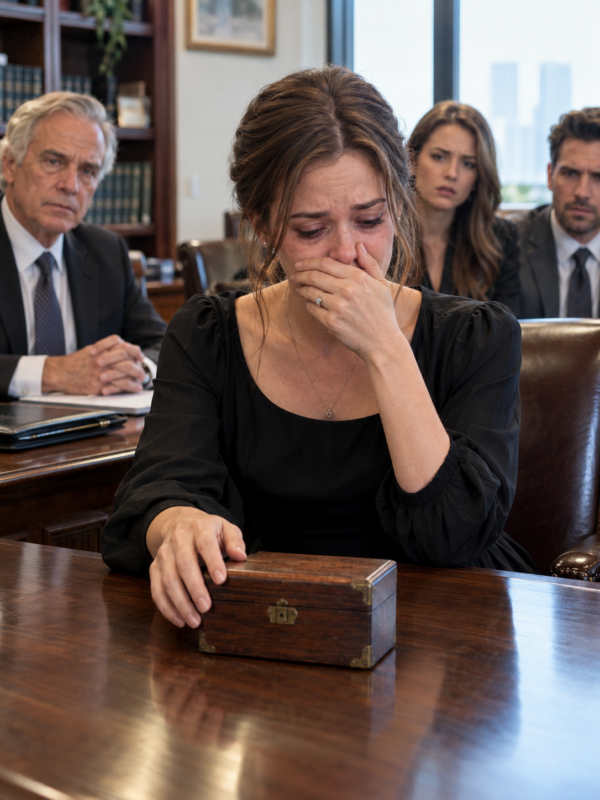
The next morning, Russell’s estate attorney called me in. When I arrived at his office, Russell’s three children were already waiting. Marlene refused to make eye contact. I prepared myself for a cold reading of the will—legal jargon, property deeds, and corporate disclosures.
Instead, a single object sat in the middle of the attorney’s desk: a simple, unadorned box made of dark wood.
I stared at it. The attorney looked around the room and said, “Russell left very specific instructions.” Marlene let out a bitter chuckle, as if she already knew how this played out.
The attorney slowly slid the box across the desk toward me and uttered the words that froze the room: “He made sure you got exactly what you deserved.”
My hands trembled as I opened the lid. Inside lay a photograph from the charity dinner where we first met. I was in the background holding a serving tray, and Russell was looking straight at me—a moment I never knew was captured. Beneath the photo was a folded letter addressed to me in his neat handwriting.
Unfolding it, my throat tightened at his opening lines. He wrote about the night he first noticed me—the exhaustion on my face, my aching feet, and how hard I kept working despite the pain.
Then came the part I wasn’t prepared for.

Russell had known all along that his children viewed me as a gold digger and suspected they would challenge his estate. To protect me, he had meticulously planned every detail long before he ever got sick. He had even voluntarily undergone a formal psychiatric competency evaluation before signing his final estate documents, completely dismantling any future claims that he had been manipulated or mentally unfit.
The attorney then unsealed the official documents. The house was mine. The controlling shares in his company were mine. The bulk of the estate was mine. His children hadn’t been cut out entirely, but their inheritances were locked into strict conditional trusts for housing, education, and medical needs—with explicit clauses stating that any bad-faith legal challenge to the will would instantly forfeit their trust allowances.
Russell had covered every angle. He had even established binding property protections so the estate couldn’t be liquidated while my child was still a minor.
My child.
I stopped reading and looked up at the attorney. “What did you just say?”
He looked at the letter in my hands and softly replied, “Russell knew.”
My heart hammered against my ribs. I looked back down at the letter. In a section I hadn’t reached yet, Russell explained that before his illness ever surfaced, he had realized I was pregnant. He had picked up on subtle physical changes before I even fully recognized them myself and had quietly arranged discreet medical care. He kept it completely secret—not even telling his children—and executed those legal papers before his diagnosis so no one could ever claim the pregnancy was used to coerce his decisions.
The room fell dead silent. Marlene stared at me, then at the attorney, her face pale. “You were pregnant?”
I sat frozen, placing a hand over my stomach. I hadn’t even had time to fully process the news myself. Yet Russell had known, and before his time ran out, he had built a fortress around the child he would never live to hold.
Marlene immediately snapped, accusing me of scheming and hiding the pregnancy during the estate planning. But the attorney cut her off instantly, pointing to the certified dates, the mental competency evaluation, and the official paper trail that proved everything was finalized well before the pregnancy could ever be used as leverage.
Yet as I sat there, the fortune, the house, and the corporate shares paled in comparison to the words in his letter.
Russell wrote that he knew the world would judge our dynamic and brand me a fortune hunter. He knew critics would never accept that genuine love had grown between us. But he insisted he didn’t want me spending the rest of my life trying to prove to hostile eyes that I was worthy of what he gave me. He wanted me safe. He wanted our child protected. He wanted me to live free from the haunting fear of financial ruin.
That was what he meant when he told Marlene I’d get exactly what I deserved. It wasn’t a warning—it was a promise of a future.
I walked out of the attorney’s office that afternoon pressing the small wooden box against my chest. I didn’t feel victorious or rich; I felt heartbroken. The man who had truly seen me when no one else did was gone, and no amount of wealth could ever fill that void.
Months later, I stood alone in his quiet kitchen, resting a hand on my growing belly. Touching the wooden box on the counter, I looked at that old photograph of an exhausted 32-year-old server carrying champagne—a woman terrified of her next bill, completely unaware that the older man watching her from across the room would change her life forever.
For the first time, I fully grasped what Russell had given me. It was never just about the money; it was about dignity, security, and the freedom to build a life without fear.
I may have entered Russell’s life seeking a way to survive, but I walked away with something far greater: a future, a child, and the quiet peace of knowing I never had to apologize for being loved.