I thought saying goodbye to the love of my life would be the hardest thing I’d ever have to do.
I was wrong.
The hardest part came afterward, when the lawyer who had stood beside us on our wedding day knocked on my door and revealed the truth: the marriage I thought was a dying man’s final wish had been something much more.
It was a trap.

Except I wasn’t the one it was designed to catch.
The rain tapped softly against the living room window of my small rented apartment as I sat at the kitchen table, slowly stirring a cup of instant coffee I could barely afford.
At seventy-three, I had returned to the town I’d walked away from when I was seventeen.
The streets had changed. The storefronts had been rebuilt, and the old houses were buried beneath fresh paint and new owners. Yet, somehow, every corner still felt familiar. That’s the strange thing about coming home: nothing looks the same, but everything feels the same.
My pension wasn’t enough to cover the cost of living, so I pinned my old nursing badge onto a fresh uniform and took a job at the local hospital—doing the same work I’d done for most of my adult life. Apparently, retirement was a luxury I couldn’t afford.
I had never married, and I had never had children. Over the years, I went on dates. There were a few kind men who made me laugh and treated me well, and there were even moments when I thought something deeper might grow. But none of them ever became Thomas.
Thomas. I hadn’t said his name out loud in more than fifty years.
He was my first love. We were both seventeen when we met—young enough to believe that loving someone meant you automatically stayed together forever, and that saying the word «forever» was enough to make it true.
I had dreams of going to college and building a life beyond our small town. Thomas chose a different path; he stayed behind to work in his father’s business.
When the day came for me to leave, he stood with me at the bus station, desperately trying to hide how terrified he was.
«Please don’t go, Nancy,» he begged.
I remember looking at him through tears. «I have to, babe. I’ve worked too hard for this.»
His face fell. «Then you’re breaking my heart.»
The bus pulled up, I climbed aboard, and that was the last time I saw him. Or at least, I thought it was. For fifty-six years, I believed that chapter of my life had closed at that bus station. I had no idea it was simply on hold.
The ringing phone pulled me back to the present. I already knew who was on the line before I picked it up.
«Nancy, honey, it’s Raymond! Just checking in on my favorite cousin.»
Favorite cousin. The phrase almost made me laugh. Raymond and I had barely spoken in thirty years, but ever since I moved back, he had been calling almost every week. He was always cheerful, always friendly—and always asking questions.
«How’s the apartment treating you?» he asked. «Rent’s a killer at our age, isn’t it?»
«I’m managing, Raymond.»
«You get everything squared away? Paperwork, a will, that sort of thing?»
I stayed quiet.
«A woman living alone needs to be careful,» he pressed.
«I’m fine, dear. Really.»
«You know, I used to visit Aunt Margaret every week before she passed,» he added smoothly. «Helped her with all her affairs. Family should look after each other, don’t you think?»
Something about the way he said it made my coffee turn bitter. I couldn’t explain why.
«That’s kind of you, Raymond, but I have to run. My shift starts soon.»
I hung up before he could push any further. At the time, I told myself I was just being impatient. Looking back, I realize my instincts were trying to warn me.
The hospital smelled the way hospitals always do: disinfectant, stale coffee, and quiet human worry.
I pushed my cart down the hallway, checking room numbers as I went. I was already tired, and it wasn’t even ten in the morning.
Room 220. New admission. Long-term care.
I knocked once and stepped inside. Opening the chart the way I had thousands of times throughout my career, my eyes skimmed the page—and then stopped dead.
Thomas.
I stared at the last name printed beneath it. My mouth went dry. It couldn’t be, I thought. There are thousands of men named Thomas. It’s just a coincidence.
I glanced toward the bed—and fifty-six years evaporated in an instant.
Thomas was thinner than I remembered. His skin was pale and his face hollowed by the illness taking over his body. But his eyes were exactly the same. They were the very same eyes that had looked at me at seventeen and begged me not to get on that bus.
He smiled—the smile of a man who had been waiting a very long time.
«Hello, Nancy,» he said softly.
I couldn’t speak. I stood there holding a blood pressure cuff, staring at the boy I had loved and the fragile man he had become. It felt as if my entire life had suddenly condensed into that single hospital room.
«Thomas,» I finally whispered, my voice breaking. «My goodness… Thomas.»
From that moment on, I found reasons to check on him during every shift. Sometimes I had a legitimate task; sometimes I didn’t. I just wanted to be near him.
We talked about everything and nothing. We laughed about our gray hair, our aching knees, and how neither of us could remember where we’d left our glasses. Some days we talked for an hour; other days, we simply sat in a comfortable silence I had never found with anyone else.
One afternoon, he looked at my coffee cup and smiled. «You still take it black?»
I raised an eyebrow. «Still do.»
«I knew it,» he chuckled.
There was a strange peace about Thomas. Most patients in his condition were frightened or angry, but Thomas was remarkably calm—like a man who had been holding his breath for decades and finally felt safe enough to exhale.
One morning, while I was adjusting his blanket, he asked casually, «Do you have family nearby, Nancy?»
«Not really.»
«Anyone looking out for you?»
«Just a distant cousin, Raymond. He’s been calling more lately.»
For the briefest second, Thomas’s jaw tightened. It was so subtle I almost missed it. Then his face relaxed, and he changed the subject to the weather. I didn’t think much of it at the time.
But Raymond’s calls grew increasingly strange that week.
«Are you seeing anyone, Nancy?» he asked one afternoon. «At your age, you shouldn’t be alone. Family should have each other’s backs.»
«I’m fine, Raymond.»
«Have you thought about a will? God forbid, but you know how these things go. Somebody responsible ought to be listed.»
«I said I’m fine.»
Then he started asking about my bank account, my apartment, and my pension. Finally, he brought up Aunt Margaret again. «I helped her with everything at the end. Everything.»
I remembered Aunt Margaret dying alone in a rented room, and how quickly Raymond had swooped in to take control of her affairs. A cold knot twisted in my stomach.
A few days later, Thomas asked me to sit beside him. His hand found mine on top of the blanket—cold, light, and almost weightless.
«Sweetheart,» he said quietly, «I feel terrible asking you this.»
«Ask me, Thomas.»
He looked directly into my eyes. «I’ve loved you my entire life. I know I don’t have much time left, but I’ve always dreamed of marrying you.» He paused, taking a breath. «Will you marry me?»
I couldn’t move. For a moment, I couldn’t even breathe. Fifty-six years of «what ifs» suddenly collapsed into a single question.
A voice inside my head—sounding remarkably like Raymond—scolded: Foolish old woman. Don’t throw your life away. Don’t let yourself be manipulated.

But another voice answered—quieter, older, belonging to the seventeen-year-old girl who had boarded that bus long ago: Say yes. For once in your life, say yes.
Thomas was dying of stage four cancer, and I realized I didn’t want to spend the rest of my days wondering if I had walked away from him a second time.
I squeezed his hand. «Yes,» I whispered, tears filling my eyes. «Thomas, yes.»
He closed his eyes for a moment, then offered a serene smile. «You won’t regret it, Nancy. I promise you that. On my life, you won’t regret it.»
At the time, I didn’t realize he wasn’t just promising a few happy days of marriage; he was promising me something far bigger.
Three days later, we were married in his hospital room.
There were no flowers or decorations. A nurse stood as one witness, and the other was a quiet man in a gray suit who introduced himself as Walter, Thomas’s attorney.
I thought it was a bit strange to have a lawyer at a bedside wedding, but Thomas squeezed my hand with such warmth that I pushed the thought aside.
We exchanged vows, our voices trembling. As soon as the ceremony ended, Walter opened his briefcase, pulled out a folder, and placed it on the rolling tray beside the bed.
«Just a few papers, Nancy,» Walter said kindly. «Standard procedure. Take your time.»
I didn’t need to read every line. I trusted Thomas with my whole heart, so I signed each document right where Walter pointed, believing it was simply part of making my dying husband’s final wish official.
That evening, my phone rang. It was Raymond.
«Have you lost your mind?!» he shouted the moment I told him. «Marrying a dying man you barely know?!»
«I’ve known him longer than I’ve known you,» I replied calmly.
«Nancy, listen to me—you’re being manipulated! Some stranger sees an old nurse with a pension, dangles a sob story, and you fall for it? Annul it today!»
«No.»
«You foolish woman! You don’t understand what you’re doing!»
I hung up, but his words lingered like a dark cloud: You’re being manipulated. For the first time, a seed of doubt crept in.
A month later, Thomas passed away peacefully early in the morning, holding my hand.
The grief hit me with crushing force. We had only been husband and wife for a few weeks, but grief doesn’t measure love by a calendar. Those few weeks held fifty-six years of waiting.
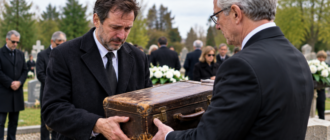
The funeral was small. As I stood by his grave, Raymond waited until most of the mourners had left before approaching me.
«You know I’m your only living relative,» Raymond said, adjusting his tie. «Family should handle family. Foolish old women shouldn’t sign papers they don’t understand, Nancy.»
Something inside me hardened. «I understood every word Thomas said to me.»
Raymond gave me a thin, chilling smile. «I helped Aunt Margaret with everything at the end. Everything. She was grateful.»
Suddenly, Thomas’s subtle reactions to Raymond’s name made complete sense—the tight jaw, the heavy silence, the abrupt change of topic.
«We’ll talk soon,» Raymond added slyly. «About your affairs.»
The following morning, a knock sounded at my door. It was Walter, carrying a small wooden box under his arm.
«May I come in?» he asked gently. «Thomas asked me to deliver this to you the day after his funeral—not a moment before.»
My heart hammered against my ribs.
«I’ve also sent Raymond a formal letter this morning,» Walter continued as he set the box on the table. «It notifies him that your affairs are now legally protected under a trust. He’ll receive it by noon.»
I blinked, confused. «What?»
Walter smiled—a sharp, triumphant look. «Thomas was right. You walked right into his trap.»
I sank into a chair, my hands trembling. Walter reached into his jacket, pulled out a folded piece of paper, and began to read:
«My darling Nancy, forgive me, but I set a trap—and you were never meant to be the one caught in it.»
Walter looked up from the page. «The documents you signed at the wedding did far more than carry out a dying wish, Nancy. One was a new will, establishing a trust funded entirely by Thomas’s substantial estate for your care and support.»
I stared at him, speechless.
«Another was a durable power of attorney naming me—not Raymond—to manage your legal and financial affairs if you ever become incapacitated. The third was your acceptance of the trust’s terms.»
Walter leaned in closer. «Raymond can never pressure you into signing anything again. Any document concerning your money or your future must go through me first. That was Thomas’s trap: a legal wall around you so no predator like Raymond could ever take advantage of you.»
All those subtle questions Raymond had asked—about my apartment, my pension, my bank account—instantly exposed themselves for what they were.
Walter pushed the wooden box toward me. «Thomas wanted you to have this as well.»
With shaking hands, I unlatched the brass hook and opened the lid. I gasped, covering my mouth as tears spilled over.
Inside lay the deed to Thomas’s family home, registered in my name. Beneath it was a thick stack of fifty-five letters tied neatly with twine—one for every single year we had been apart.
On top rested a note in Thomas’s familiar, careful handwriting.
In the letter, Thomas explained that Aunt Margaret had been a loyal customer at his father’s store for decades. Thomas had discovered that Raymond was secretly siphoning money from her accounts, but when he tried to warn her, Margaret refused to believe her nephew could do such a thing. When she died, Raymond walked away with her life savings.
Thomas had kept a watchful eye on Raymond ever since. When he learned I had moved back to town, he knew Raymond would target me next. That was why Thomas requested a transfer to my hospital ward. He knew what Raymond was planning, and he used his final days to build an airtight fortress around me.
Three days later, Raymond came pounding on my door, red-faced and furious, waving papers and shouting about undue influence.
He didn’t expect to find Walter calmly sitting at my kitchen table, sipping tea.
Walter let Raymond rant until he ran out of breath, then said coolly, «Every document is airtight. Contest it if you like; you’ll lose, and you’ll pay our legal fees.»
Raymond turned to me, his face twisted in rage. «You foolish old woman!»
I stood up straight, looked him dead in the eye, and spoke with a confidence I had never felt before:
«No, Raymond. I am a woman who was loved. There’s a difference.»
He left without another word.
That spring, I moved into Thomas’s family home.
Every Sunday morning, I make myself a cup of black coffee, sit by the window, and open one of his letters. I read about the years we missed, the life we might have shared, and the love he carried for me through decades of silence.
For fifty-six years, I thought I had left my first love behind at a bus station. I thought life had given me one chance at love and I’d missed it.
I was wrong. Love hadn’t passed me by—it was waiting for me.
Thomas didn’t just leave me a home or financial security; he gave me the greatest gift of all. He saw the danger coming, protected me when I was vulnerable, and proved that a love born at seventeen could still shelter me at seventy-three.