I lay against the cold marble floor, struggling to catch my breath. Just a few feet away stood my husband, Preston Whitcomb. He made no move to help me, nor did he offer a single word to correct his mother’s vicious version of what had just happened.
My father must have said something on the line that caught Eleanor off guard, because she let out a short, dismissive laugh. “You really have no idea who you’re dealing with, do you?”
She pulled the phone away from her ear, but the volume was up high enough for me to hear Dad’s voice—calm, steady, and carrying a quiet weight that sent a chill through me.
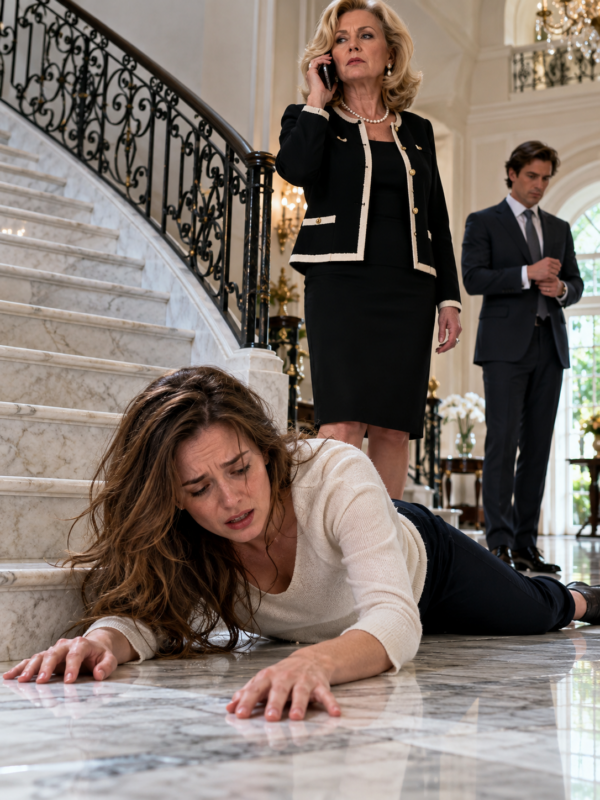
“If my daughter has been harmed, Eleanor, I expect every single person involved to answer for it.”
She hung up without another word.
For nearly nine years, I had convinced myself that the Whitcombs were simply difficult people—the kind of old money that breeds arrogance and cold detachment. But as I watched Preston casually straighten his cuffs while we waited for the ambulance, the illusion shattered. Their polished, country-club manners didn’t just mask everyday family friction; they concealed something far more sinister.
By the time I reached the hospital in Richmond, Virginia, the emergency room doctors had diagnosed two fractured ribs, a severely strained shoulder, and a constellation of injuries that would require weeks of strict bed rest. Yet the physical pain was the least of my worries.
My seven-year-old daughter, Lily, had been upstairs when the argument broke out. I had no idea if anyone had bothered to comfort her—or if Preston’s parents were already scheming to keep her away from me.
I worked part-time as a speech therapist at a local elementary school. While I earned enough to contribute to our household and structured my entire life around Lily’s schedule, I knew how the Whitcombs operated. With their sprawling estate, high-priced legal team, and deep political connections, they could easily twist my modest life to make me look like an inadequate mother.
That afternoon, a distinguished-looking attorney walked into my room carrying a worn leather portfolio. I naturally assumed Preston had sent him.
Instead, he introduced himself as Jonathan Hale and explained that my father had retained him.
“Your daughter is with your father, Mrs. Whitcomb,” he assured me before I could even panic. “She’s safe, and we’ve already taken steps to keep it that way.”
Tears of absolute relief flooded my eyes.
Then Jonathan placed a stack of legal documents across my blanket. Preston’s family had already filed for emergency custody, painting me as emotionally unstable, financially reckless, and incapable of caring for Lily.
I stared at the paperwork, my hands shaking. “They know I take care of her,” I whispered. “I’m the one who drives her to school, helps with her homework, and stays up all night when she’s sick.”
Jonathan nodded, his expression grave. “Your father knows that too. And he’s spent his career making sure powerful people can’t rewrite the facts to suit their own narrative.”
I looked at him, completely baffled. My father lived in a modest brick home outside Charlottesville, drove an aging sedan, and had always described his career as routine government administrative work.
Jonathan paused, then gently set the record straight. Arthur Dawson hadn’t been a low-level clerk. For decades, he had directed complex federal investigations into financial fraud, public corruption, and untouchable organizations whose leaders thought their status placed them above the law.
It was almost impossible to connect that reputation with the man I knew—the dad who clipped grocery coupons, repaired his own porch steps, and never missed one of Lily’s school plays.
When Dad walked into the room a few minutes later, draped in his familiar brown cardigan, I saw him with entirely new eyes. The quiet authority in his posture was unmistakable.
Yet the moment his eyes met mine, all that professional hardness melted into pure warmth.
“There you are, sweetheart,” he murmured, stepping forward to take my hand.
I burst into tears before I could even reply.
Over the years, Dad had gently asked if I was truly happy in my marriage. Back then, I had brushed off his concern, assuming he simply didn’t appreciate the comfortable life Preston provided—especially since the Whitcombs never missed an opportunity to remind me how lucky I was to belong to their family.
Sitting beside my hospital bed, Dad didn’t bring up those old conversations. He didn’t say I told you so.
Instead, he squeezed my hand and said softly, “We’re going to handle this one fact at a time, and you are not going through it alone.”
That’s when Jonathan opened a second folder.
And I discovered that the custody petition was only the tip of the iceberg.
Part Two: The Signature That Wasn’t Mine
The Whitcomb family owned a regional commercial property company that developed shopping centers, medical offices, and residential communities across Virginia and the Carolinas. While Preston occasionally grumbled about construction deadlines over dinner, he had always insisted that the financial details were far too complicated for me to worry about.
I had believed him—partly because my own world revolved around children rather than business contracts, and partly because I had grown conditioned to accepting his smooth reassurances whenever a question made him uncomfortable.
Jonathan explained that several recent transactions involving the family company had triggered red flags with financial regulators, particularly payments made to shell consulting firms and loans backed by suspiciously complex guarantees.
Then he turned a page and showed me a document bearing my name.
According to the paperwork, I had personally guaranteed a massive business obligation for one of the Whitcombs’ subsidiary companies.
At the bottom of the final page was a signature that looked convincing at a glance—close enough to fool someone who had never watched me write. But as I studied the letters, my stomach dropped. The final curve was wrong, and the capital
D had been formed in a way I had never, in my life, written it.
“I didn’t sign this,” I told him.
“That’s what your father suspected,” Jonathan replied. “And we have records that will help us prove it.”
Memory crashed over me in a cold wave. I recalled Preston bringing stacks of papers home after dinner, spreading them across the kitchen table while I prepped Lily’s lunch for the next day, casually telling me they were just routine insurance renewals or household administrative forms.
Whenever I paused to read the fine print, he would sigh and remind me that his family’s accountants had already combed through everything.
Sometimes, I signed just to stop him from making me feel foolish for asking.
Dad listened quietly without interrupting. When I finally admitted how deeply embarrassed I felt, he reached out and squeezed my hand.
“Marriage is supposed to make trust possible, not turn it into a weapon someone else can exploit.”
Jonathan then laid out several credit reports filled with unfamiliar inquiries, alongside a summary of the ammunition Preston’s attorneys planned to use against me. A single late utility payment from the previous winter was being framed as reckless irresponsibility, while the fact that Preston handled all our accounts was being twisted to prove I lacked financial independence.
The portrait they were painting of me bore zero resemblance to reality, yet every fabricated detail had been carefully chosen to support one overarching narrative: I was unstable, helpless, and completely dependent on my husband.
Dad had already hired Jonathan because of his expertise in complex family asset concealment and forged financial documents. But what stunned me most was learning how long my father had been quietly digging.
“Why didn’t you tell me?” I asked, my voice catching.
He looked genuinely pained. “Because I didn’t want suspicion to turn into an accusation before I had hard proof, and because I knew how desperately you wanted your marriage to work.”
He reminded me of the previous spring, when Preston had tried to make me sign a broad power-of-attorney form allowing him to manage my personal affairs. I had called Dad for advice before signing, and Dad had urged me to demand a clear explanation. Preston had been furious with me for days afterward.
Now, looking back, I wondered if that single refusal had saved me from something far worse.
Before Jonathan could answer another question, his phone buzzed. He listened intently, excused himself into the hallway, and returned a moment later with a grim look.
A caller claiming to represent the Whitcomb company’s insurance provider had just phoned the hospital, aggressively demanding details about my admission and my visitors.
The hospital staff had rightfully shut them down.
Dad’s expression turned steely. “They aren’t just trying to control the narrative anymore,” he said. “They’re trying to figure out what we have.”
For the first time, a terrifying thought crossed my mind: Had my fall down the stairs given Preston’s family an opening they had been desperately waiting for?
Part Three: The Blue Book
That evening, a nurse helped arrange a brief visit with Lily. She walked in wearing her favorite lavender sweater, clutching a folded drawing in both hands with exaggerated care, clearly trying to remember every instruction she’d been given about being gentle with Mommy. The sight of her worried little face nearly broke me.
“Grandpa says you’re getting better,” she announced softly.
“I am, sweetie. I just need a little rest.”
She scrambled onto the chair beside me and unfolded her picture—a crayon drawing of a small house surrounded by a sea of flowers, featuring bright blue windows and a bright yellow front door.
“That’s where we’re going to live,” she declared proudly.
I managed a bright smile, though I had no clue where we’d be living next month. “Why did you make the windows blue?”
Before Lily could answer, her eyes drifted to Jonathan’s paperwork on the table. She spotted a photograph of our staircase and asked why the police had been taking pictures of our house.
I kept my voice light, explaining they were just checking things out, taking great care not to burden her or place any blame on her shoulders.
She glanced nervously toward Dad, then murmured that Preston had been in a foul mood that morning and that her grandmother had ordered her to stay locked in her room upstairs.
Then, her eyes lit up with a child’s sudden memory.
“Oh! Grandma told Daddy to go get the papers from the blue room.”
The «blue room» was Eleanor Whitcomb’s private sitting room, a restricted space adjoining her husband’s study at the main estate where sensitive records and family correspondence were kept behind locked glass cabinets.
I remembered wandering into that room the previous Christmas while hunting for scrap paper for Lily. Sitting right out in the open on the mahogany desk had been a thick, navy-blue record book secured with a heavy brass-colored clasp. At the time, I hadn’t given it a second thought.
Now, the memory felt electric.
After Lily left with Dad’s long-time neighbor, who had kindly stepped in to help watch her, Jonathan leaned forward. “Do you remember anything else about that book?”
I searched my memory. A few months earlier, I had visited the estate with Lily, who had dropped her stuffed rabbit right near the office doorway. As I bent down to scoop it up, I caught sight of Preston’s father deep in conversation with a woman who had auburn hair pinned into a loose knot.
They froze the second I appeared. I remembered the woman instantly glancing toward a blue folder on the desk, and Preston’s father hastily slamming a drawer shut.
The memory sparked another: just the night before my fall, Preston had casually asked if I still kept the old appointment notebooks I used before Lily started school—the ones shoved away in a wicker basket beneath the staircase.
Jonathan didn’t waste a second. He immediately arranged for investigators to secure and inspect the basket during their search warrant execution at the house.
Shortly after, an investigator texted Jonathan a photo of an envelope discovered wedged beneath the small accent table beside the stairs.
My name was written across the front in Eleanor’s sharp, precise handwriting.
Beneath it, in smaller letters, was a chilling message:
For the day you begin questioning what you remember.
I stared at the photograph until my eyes blurred.
The smaller handwriting below was unmistakably mine—the way I looped my letters, the slight upward slant, the distinct curve on the final word.
Yet I had zero memory of writing it.
Dad sat quietly beside me while I tried to process how a piece of my own handwriting could exist for a moment I couldn’t recall.
“You don’t have to figure it all out tonight,” he said gently.
But a cold realization was settling deep into my bones: somewhere amid the wreckage of my marriage, I had anticipated this exact trap—and left myself a lifeline.
Part Four: The Woman Who Came Forward
The following morning, a woman named Rebecca Sloan arrived at the hospital alongside an investigator.
She had auburn hair, a faint pale scar near her eyebrow, and the haunted, exhausted look of someone who had spent sleepless weeks wrestling with her conscience.
I recognized her instantly as the woman from the Whitcomb estate office.
Rebecca explained that she had worked as a senior financial records specialist for the family corporation before walking off the job weeks earlier, unable to stomach the financial irregularities she was uncovering. What she originally thought were simple accounting errors turned out to be a web of ghost companies, fabricated invoices, and massive debt obligations funneled through shell corporations.
Even worse, corporate guarantees were being systematically attached to individuals who had never consented.
My name was right at the top of the list.

“You came by the office last October asking questions about your signature,” Rebecca told me quietly. “You were far more observant than they expected.”
She slid a copy of an old compliance document across the table. Right in the margin next to a suspicious paragraph were my actual initials and a handwritten query asking for clarification.
The memory flashed back: sitting at our kitchen table, questioning an insurance rider Preston had handed me. He had promised to look into it with the company accountant.
According to Rebecca, that exact page had later been swapped out for a clean signature page. She had kept a photocopy because the blatant forgery made her skin crawl.
“I should have spoken up sooner,” she admitted, her voice trembling.
Dad answered before I could. “You’re speaking up now. And that is what counts.”
Rebecca went on to explain that after I discovered my name on financial paperwork I’d never seen, I had returned to the office demanding answers. She had shown me entries from the navy-blue record book. Terrified, I had insisted on copying the pages.
Rebecca remembered helping me slip those copies into a blue folder, along with a note I had frantically written to myself because I was terrified Preston would eventually gaslight me into doubting my own sanity.
As she spoke, the fog lifted. Pieces of that rainy afternoon clicked into place:
The steady drum of rain against my windshield.
A blue folder resting on the passenger seat.
Preston standing by my car door, using that soft, patronizing voice designed to make me question my own mind, insisting his father was just weathering a temporary liquidity crunch and that making noise would humiliate the family name.
I had wanted to believe him so badly. That was the most agonizing part.
Rebecca knew I had hidden those copies somewhere safe, though she didn’t know where—only that I had mentioned Lily’s old kindergarten backpack and an old appointment planner.
That evening, as I watched via a secure video feed from my hospital bed, an officer unzipped the wicker storage basket beneath the staircase at our house. Inside lay old wrapping paper, dusty books, a worn plush rabbit, and Lily’s faded purple preschool backpack.
The officer carefully unzipped the inner lining.
There, tucked between an old fingerpainting and a school portrait, sat the blue folder.
I threw a hand over my mouth as he lifted it to the camera. Inside were the duplicated ledger pages, forged corporate correspondence, and a handwritten note I recognized instantly:
If I ever start doubting myself, remember: asking questions is not a crime. I saw what I saw, and I have every right to the truth.
I had written those words while sitting in my car outside the office, shaking with fear yet fiercely determined to leave a trail of breadcrumbs for the person I would eventually become.
Tucked in an envelope inside the folder was a small brass key. Later authorized searches linked it to a secure lockbox in a commercial storage facility registered under a Whitcomb subsidiary.
The evidence trail was wide open.
Part Five: The Custody Hearing
The emergency custody hearing took place the following afternoon. With my doctors’ clearance, I attended remotely from my hospital bed.
Preston’s parents marched into the courtroom looking as immaculate and unbothered as ever, flanked by high-priced attorneys who framed their emergency petition as a noble effort to shield Lily from a chaotic home environment. Their entire case hinged on my physical injuries, my alleged financial instability, and cherry-picked school attendance logs trying to paint me as an absentee mother.
Jonathan didn’t waste time with theatrical speeches. He simply laid out the evidence with surgical precision: medical records, police reports, corroborated timelines, and an avalanche of communications from Lily’s teachers proving I was an intensely dedicated, active mother.
The school district completely dismantled the Whitcombs’ fabricated attendance claims. Then, Rebecca took the stand and delivered a devastating, sworn account of the forged corporate paperwork—backed by physical ledgers that pointed squarely at systemic fraud.
The judge made it clear that while complex corporate fraud trials belonged in another courtroom, the blatant bad faith and fabrications in the Whitcombs’ custody claims could not be ignored.
When Preston’s attorney tried to argue that my hospital stay rendered me an unfit parent, Jonathan calmly pointed out that temporary physical recovery does not erase years of devoted parenting, especially when a safe, loving family support network was already in place.
The judge slammed the gavel down. Emergency petition denied.
Lily would remain in my custody, staying safely with Dad while I finished healing, while Preston’s access would be strictly monitored under court-ordered protective guidelines.
I listened to the ruling with quiet tears streaming down my face. There was no cinematic courtroom outburst, no dramatic confession on the witness stand, no magical moment where everyone stood up to applaud my father’s legendary career.
Dad hadn’t pulled strings or asked for favors. He had simply equipped me with top-tier legal defense, helped me protect the evidence, and made sure my voice was finally allowed to be heard.
Later that evening, Dad walked into my room carrying a fresh drawing from Lily.
It showed three stick figures smiling outside a little house under a bright blue sky. Across the bottom, in her wobbly kindergarten print, she had written:
Home is where we tell the truth.
Dad set it gently on my bedside table. “She wanted to make sure you saw it before lights out.”
I smiled through my tears. “She has a way of cutting straight to the heart of things, doesn’t she?”
He chuckled softly, and for a long time, we sat together in the quiet room without uttering a single word about lawyers, court dockets, or the long road ahead. It felt incredible to just talk about nothing more complicated than a child’s crayon drawing.
Part Six: A Home with Clear Windows
My physical recovery took longer than expected, and the legal battles dragged on long after the emergency custody ruling.
The federal financial investigation snowballed, leading to formal indictments against key executives within the Whitcomb corporate umbrella. Preston ultimately cut a deal once the forged guarantees and corporate paper trails were laid bare by investigators.
Our divorce was finalized the following spring.
I didn’t walk away with a multi-million-dollar settlement, nor did I suddenly become rich off my father’s past government service. I kept my savings, gradually resumed my speech therapy work, and set about rebuilding the quiet, ordinary routines I had once foolishly taken for granted.
Dad converted his home study into a cozy bedroom for me, and Lily settled into the house with joyful enthusiasm—largely because Grandpa let her flip pancakes on Saturday mornings and never once yelled when she left her colored pencils scattered across the dining room table.
Rebecca continued cooperating with federal investigators and eventually landed a stable position at a respected independent accounting firm. We stayed in touch—not because our shared trauma defined us, but because we both understood the heavy cost of speaking truth when powerful people demand silence.
I also started seeing a counselor to untangle why I had spent years normalizing emotional abuse and why the sharp sound of footsteps near a staircase could still trigger my heart to race.
Healing wasn’t about erasing the past. It was learning that the past no longer got to dictate my future.
Several months post-divorce, Lily and I found a bright, charming apartment overlooking a tree-lined courtyard. It had a sunny kitchen, a balcony large enough for terracotta pots, and wide, beautiful windows that let the sunlight pour in.
When Lily asked if we could plant marigolds, I bought two packets of seeds and let her pick out the pots. Dad helped us haul furniture up the stairs and spent an entire Sunday afternoon hammering nails to hang our pictures—right alongside Lily’s framed drawing of our little house.
I placed my old handwritten note in a simple wooden frame right beside it.
For a long time, I had considered throwing that note away because it hurt to look at what I had nearly lost. But eventually, I realized it represented something infinitely more valuable: proof that even when I was terrified, isolated, and gaslit, a part of me always knew I deserved the truth.
On the one-year anniversary of the morning I walked out of the Whitcomb estate, Dad came over for dinner carrying a small lemon cake from our favorite neighborhood bakery.
A gentle spring rain tapped against the glass while Lily arranged paper napkins around the kitchen table, proudly announcing that the marigolds on our balcony had sprouted six bright new blooms.
After dinner, Dad raised his mug of tea.
“To the home you’ve built,” he said quietly.
Lily hoisted her plastic cup of apple juice. “And to windows we can actually see through!”
We all laughed, though I felt a familiar prickle of tears behind my eyes as I looked around our little kitchen.
For years, I had mistaken an imposing mansion for a secure home, believing that granite countertops, manicured hedges, and an elite family name could compensate for the suffocating dread I carried in my chest every single day.
Our new apartment was a fraction of the size of the Whitcombs’ dining room, and the mismatched kitchen cabinets certainly didn’t match designer standards. But here, Lily could laugh without walking on eggshells, and I could ask a question without bracing myself for an apology.
Later that evening, after Lily had drifted off to sleep, Dad stepped out onto the balcony with me as the rain tapered off into a soft mist.
“You know,” I told him, looking out over the courtyard, “when Jonathan first told me who you really were, I thought your federal career was going to be the thing that saved us.”
Dad smiled, leaning against the railing. “It certainly helped me know which questions to ask.”
“But that wasn’t the most important part.”
He turned, waiting.
I glanced through the open balcony door toward Lily’s drawing, hanging right beside my framed warning.
“You believed me before you had a single piece of paper.”
His expression softened, the lines around his eyes crinkling. “You’re my daughter. I knew your character long before I ever saw a corporate ledger.”
For a moment, neither of us spoke.
Then he rested his hand gently on my shoulder—the exact same comforting weight I remembered from when I was a little girl—and we turned back inside to finish washing the dishes.
People often ask what finally gave me the courage to walk away from my marriage, expecting me to name the staircase, the custody battle, or the forged financial crimes. But I’ve never been able to separate those massive milestones from the quiet, everyday realizations that followed.
I learned that love cannot survive where honesty is treated as a threat. I learned that a respected surname means nothing without integrity. And I learned that asking for help is often the bravest, most revolutionary act a person can make.
Most of all, I learned that a true home isn’t measured by property values, prestigious addresses, or the powerful people who claim dominion over it.
A home is simply a place where a child feels safe to speak the truth, where a simple question is met with an honest answer, and where the people who love you never ask you to make yourself smaller just to fit in.
Our windows were clear, our marigolds were thriving, and the life waiting beyond them was finally ours to choose.